
What is non-running car shipping and who is it for?
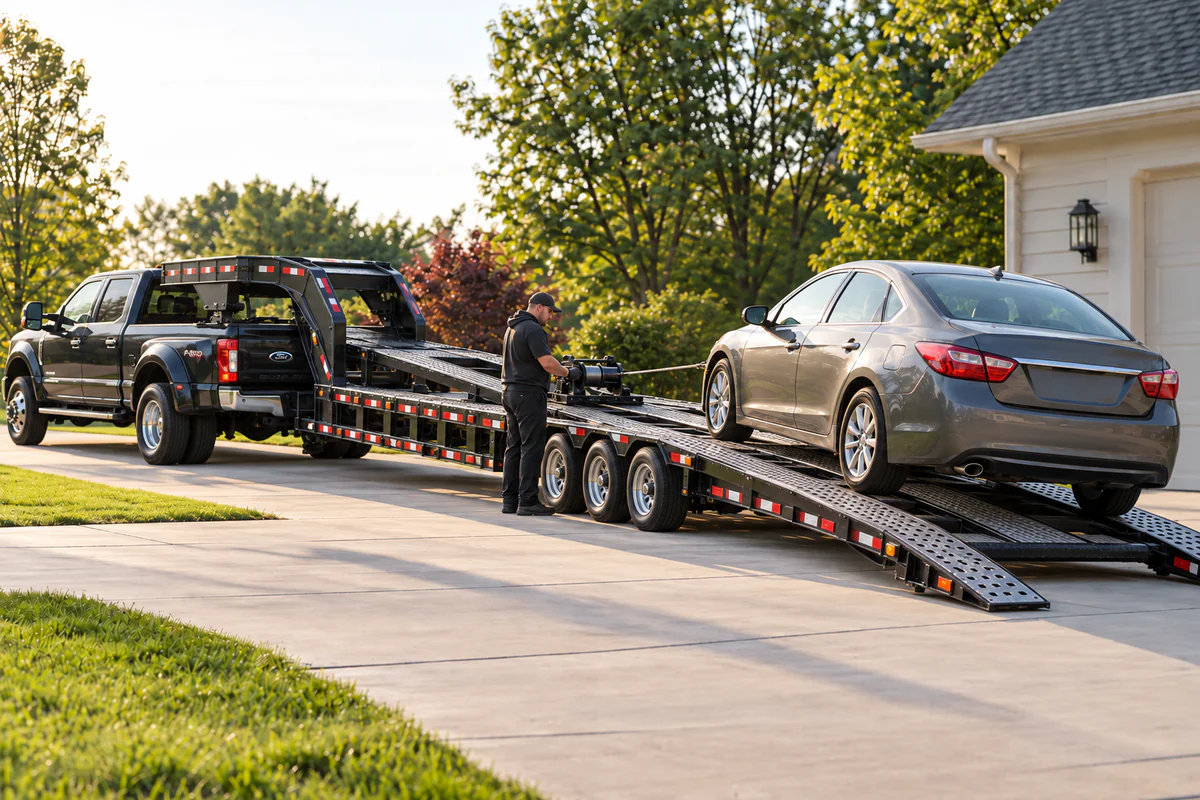
If your car can't be driven onto or off a trailer under its own power, it ships with a carrier that carries a winch, forklift or liftgate. That is non-running car shipping.
"Non-running" is what most people say, but usually it just means the engine won't start. The industry term is inoperable vehicle, and it covers more than that: a car with a dead engine that still rolls, steers and brakes is a very different loading job from one whose engine runs but whose wheel is seized or steering is locked. The first can be winched up an ordinary open carrier's ramps. The second can't. That three-part check (does it roll, does it steer, does it brake) is what a dispatcher needs to know, not just whether the key turns. Your car belongs here if it fails that check for any reason: a dead battery that won't hold a jump, a blown transmission, accident damage, or a salvage-titled car you picked up at auction.
What does non-running car shipping cost?
Your base transport charge prices the same way as any shipment, by distance and vehicle type. The loading fee on top of it is set by the carrier once they see your car's real condition, so we don't publish a number for it here.
See how much it costs to ship a car for the base reference range by distance. The extra charge for winch, liftgate or forklift work varies by carrier and by how bad the condition actually is, so get it in writing once your car's condition is confirmed, rather than trust a number that isn't specific to your car.
How does booking a non-running car shipment actually work, step by step?
Booking a non-running shipment adds one thing to the standard process: telling us your car's exact condition so we assign a carrier with the right equipment before a truck shows up.
- 01
- 02
- 03
- 04
- 05
Non-running car shipping vs. standard car shipping - what's actually different?
A standard car-shipping order lets any carrier load the vehicle by driving it up the ramps, while a non-running car shipping order needs a carrier equipped with a winch, liftgate or forklift instead.
| Factor | Standard (running) order | Non-running order |
|---|---|---|
| Loading method | Your car drives onto the trailer under its own power. | Winched, lifted or forklifted into place, depending on whether it rolls, steers and brakes. |
| Carrier pool | Any open or enclosed carrier on the route can bid. | Only carriers whose truck matches your car's specific failure (winch-capable vs. lift-only) can bid, which makes a smaller pool. |
| Price impact | Base distance-and-vehicle-type reference range only. | The same base range, plus a carrier-set loading fee confirmed at booking or pickup. No fixed public rate exists for it. |
| Booking information needed | VIN, pickup address, delivery address. | The same three, plus telling us whether your car rolls, steers and brakes. |
| Risk if condition is disclosed wrong | Minimal. A running vehicle either loads or it doesn't. | The assigned truck may lack the right equipment on arrival, which can send your load back into the dispatch pool. |
When non-running car shipping is NOT the right choice
If your car still starts, rolls, steers and brakes on its own, book standard car shipping instead. A non-running order adds a fee your car doesn't need.
A dead battery you've already jumped, a check-engine light with a repair scheduled after delivery, or cosmetic damage on a car that otherwise drives fine: none of that is a reason to book a non-running order. Your car can still be driven up the ramps, which is exactly what open car shipping and enclosed car shipping already cover at the standard rate. A car that is both salvage-titled or auction-bought and non-running needs this page's equipment steps plus the lot-number, buyer-number and gate-pass steps a lot release requires. Those are auction requirements and not shipping-condition ones, so they are covered separately.
What we do and don't do for a non-running vehicle
We arrange non-running car shipping by dispatching to carriers in our network that carry winch, liftgate or forklift equipment. We never commit to a fixed dollar amount for that extra loading work upfront.
We don't own a winch, a forklift or a liftgate. As a broker, we match your shipment to a carrier whose own truck carries the right equipment for your car's disclosed condition — we don't haul the car ourselves. We can transport damaged and non-running vehicles using specialized equipment, and there may be an additional fee for loading or unloading one. We won't promise a specific pickup speed or a capped fee, because that depends on your car and the carrier assigned to it. See the line between what a broker arranges and what a carrier physically does on the broker vs. carrier comparison.
Non-running car shipping FAQs
- Can Wave ship a car that won't start?
Yes. We arrange transport for damaged and non-running vehicles using specialized loading equipment. What equipment depends on whether your car still rolls, steers and brakes — see the difference between a non-running car and an inoperable vehicle below.
- What's the difference between a non-running car and an inoperable vehicle?
Non-running is what most people say when the engine won't start, but inoperable vehicle is the broader industry term for anything that can't be driven onto a trailer under its own power — including a car whose engine runs fine but whose steering is locked or whose wheels won't turn.
- How much extra does it cost to ship a non-running car?
We don't publish a number for the loading fee. The carrier sets it once they see your car's real condition. Get a live quote for a current price once that's confirmed.
- Will a winch work on any car that won't start?
Only if it still rolls, steers and brakes. A winch pulls the car up the ramp, but the wheels still have to turn freely and the steering still has to track straight. A car that fails any one of those three needs a liftgate, a forklift or a flatbed with dolly skates instead.
- What if my car has a dead battery but otherwise drives, steers and brakes fine?
A dead battery alone doesn't make your car non-running for booking purposes if it can still be pushed or towed onto the ramps under its own rolling, steering and braking ability. Book the standard open car shipping listing, not a non-running order.
- Does shipping a non-running car bought at a salvage auction cost even more?
Depends which fee you mean. The auction house's own storage and gate-pass fees are separate charges billed by the auction, not by us, and are covered on the auction car shipping page. This page's equipment fee applies whether or not your car came from an auction.
- What happens if my car's actual condition doesn't match what I booked?
A driver who shows up expecting a winch-loadable car and finds one that won't roll, steer or brake at all can't load it with the equipment on hand. That can send the load back into the dispatch pool for a truck with the right equipment instead of loading that day. Tell us the real condition at booking, not just whether the engine starts, and that doesn't happen.
Last checked