
What is classic car transport and who is it for?
If your car's value depends on its exact cosmetic and mechanical condition, we arrange transport on open or hardside enclosed trailers depending on what it's worth, not how old it is.
You're probably one of a few types: an owner moving a matching-numbers restoration to a new home or a concours event, a collector picking up an auction win, a rebuilder relocating a project car that may not run at all, or a dealer moving a low-production exotic. Age alone decides nothing here. A 30-year-old commuter sedan with no collector value ships the same way any ordinary used car does, and open car shipping covers that booking directly. What changes the approach is value concentrated in condition: original paint, factory-correct trim, an unmolested interior, or a numbers-matching drivetrain, where a scuff that's cosmetic on a daily driver is the entire claim on a collector car.
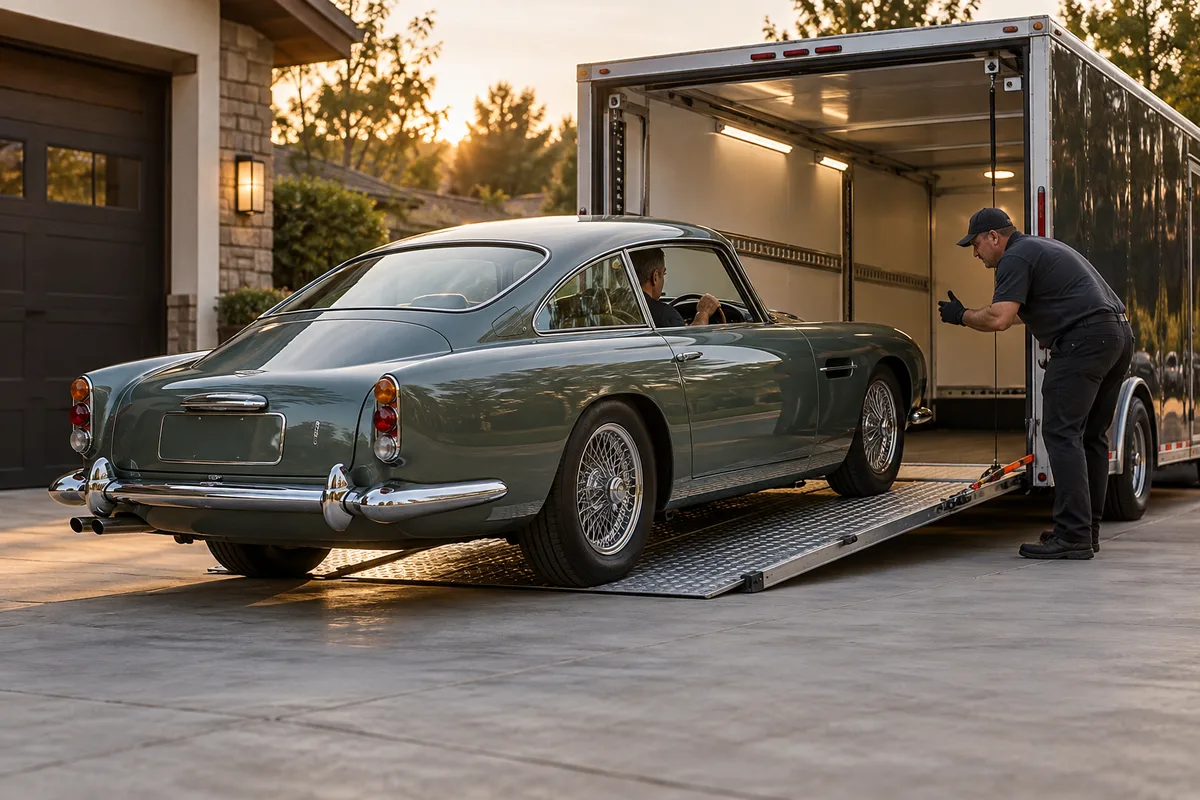
What does classic car transport cost?
Classic cars have no separate price range. Your transport leg is priced by distance and transport type, the same ranges every other customer sees, not by whether your car is a collector car.
See how much it costs to ship a car for the open-transport ranges by distance, and enclosed car shipping for the enclosed range up to 500 miles. On a classic, what changes the cost conversation is rarely the car's age. It is the loading method a non-running or low-clearance car needs, and whether you want a single-car enclosed trailer instead of a multi-car one. Both are covered below. Before booking, confirm the assigned carrier's own cargo insurance limit against your car's declared value, since a collector car's replacement cost can run well above what a standard per-vehicle cargo policy caps at. See cargo insurance for why that limit comes from the carrier's own policy and not a fixed federal minimum.
How does classic car transport work, step by step?
Classic car transport follows the same process as any Wave shipment, except that the pickup inspection is paint-and-panel focused, the loading method may be winch or liftgate instead of driving on, and the trailer may be single-car instead of multi-car.
- 01
- 02
- 03
- 04
- 05
Classic car transport vs a standard car-shipping order
Classic car transport uses the same booking process as a standard order and adds handling for value: more inspection detail, a different loading method and a choice of trailer.
| Factor | Standard car-shipping order | Classic or collector car transport |
|---|---|---|
| Trailer type most often requested | Open multi-car carrier is the default choice. | Enclosed, hardside trailer is a common request, though open transport remains available and costs less. |
| Pickup and delivery inspection focus | Dents, scratches, and existing mechanical issues get recorded on the bill of lading. | Same document, but paint condition, panel gaps, and factory-original parts get the same level of detail, because that's what the value is measured against. |
| Loading method assumed | Driven on and off the trailer under its own power. | Winch loading or a liftgate is common for a non-running project car or a low-clearance body, independent of whether the car is damaged. |
| Trailer sharing | Multiple vehicles loaded together on one open or enclosed trailer is routine. | A single-car enclosed trailer is sometimes specifically requested to remove the risk of another vehicle's straps or overhang contacting the bodywork. It narrows the available carrier pool. |
| Insurance conversation before booking | The carrier's cargo policy limit rarely comes up before pickup. | Worth asking for the assigned carrier's per-vehicle cargo limit in writing, since a collector car's replacement value can exceed a standard limit. We don't publish our own coverage figure. |
When classic car transport treatment is NOT necessary
If your car has no exceptional collector value, no numbers-matching drivetrain, and no cosmetic sensitivity, skip the single-car enclosed treatment and the paint-focused inspection. Open car shipping is the standard, cheaper choice.
Age alone is a poor signal here. A car built decades ago that's been a daily driver its whole life, with no restoration history and no collector demand, ships the same way any ordinary used vehicle does: open transport, standard multi-car trailer, the usual dents-and-scratches inspection. The deciding question is whether a mark on the bodywork would meaningfully change what the car is worth, not how old the title says it is. For the general enclosed-vs-open decision, its reference range, and the hardside-only standard, see enclosed car shipping directly.
What we do and don't do for classic and collector vehicles
We arrange both open and enclosed transport for classic and collector vehicles through vetted carriers in our network, dispatching only hardside enclosed trailers for enclosed service, and we don't publish a specific dollar figure for our cargo insurance coverage.
We're a licensed property broker: we arrange the carrier match and don't operate the trucks ourselves. Enclosed service for a classic follows the same hardside-only standard as any other enclosed booking. We dispatch no softside, tarp-style trailer for any shipment, classic or otherwise. We're licensed and insured, but we haven't published a per-vehicle coverage limit, so the coverage your classic gets is set by the assigned carrier's own cargo policy and not by a figure from us. See cargo insurance for how that limit is set. Weather-related exclusions on an open shipment also live in the carrier's own policy wording, not in a list we publish. See acts of God exclusion for what that kind of clause typically covers and where it comes from.
Classic car transport FAQs
- Is luxury car transport different from classic car transport?
Not in how you book it. A luxury or exotic car goes through the same booking steps as a classic, and we recommend enclosed transport for both without requiring it. Ground clearance is covered in the low-clearance question below.
- Is enclosed transport required to ship a classic car?
No. We recommend enclosed for classics, luxury vehicles and other high-value cars, but we don't require it. An older car with no significant collector value or cosmetic sensitivity ships fine on open transport; see when classic car transport treatment is not necessary for the deciding factors.
- How much does classic car transport cost?
There is no classic-specific price range. Your transport leg is priced by distance and transport type, not by your car's collector status. See the enclosed car shipping reference range for enclosed pricing and how much does it cost to ship a car for the open-transport ranges.
- What is the difference between a single-car and a multi-car enclosed trailer?
A single-car enclosed trailer carries one vehicle at a time, which removes the risk of another vehicle's straps, mirrors, or overhang contacting the bodywork during transit. A multi-car enclosed trailer carries several vehicles loaded together and is more common on most routes, because more carriers run them. Which type you get depends on carrier availability on that route, so ask about it when getting a quote if it matters for your car.
- Does Wave's cargo insurance cover a classic car's full value?
We haven't published a specific cargo insurance dollar limit. A car hauler's cargo policy limit comes from that carrier's own insurance contract, not a fixed federal minimum set for a passenger vehicle. See cargo insurance for why. Ask the assigned carrier for its certificate of insurance and per-vehicle limit in writing before pickup, and disclose your car's declared value up front if it's likely to exceed a standard limit.
- Does a non-running classic cost more to ship?
Usually yes, because a non-running car needs winch loading or a liftgate instead of driving onto the trailer under its own power, and that equipment and time is what a non-running vehicle surcharge covers. See non-running car shipping for how that surcharge is set. Many classics are non-running for reasons that have nothing to do with damage, such as a mid-restoration engine pull, which is worth stating clearly when booking either way.
- Can a low-clearance classic use standard loading ramps?
It depends on ground clearance, not on whether your car runs. A front splitter, lowered suspension, or trailer-queen ride height can bottom out on a standard ramp's break-over angle even with a healthy engine. The fix is a carrier equipped with a liftgate or ramp extensions, not a different price tier. Disclose your car's ground clearance when booking so we can match a carrier that already carries that equipment.
- What happens if new paint damage shows up at delivery?
New paint damage found at delivery gets compared against the pickup condition report, which is the baseline record a damage claim is built from. A mark not on that pickup record is much harder to attribute to the carrier. A repaired paint chip or scratch can also raise a diminished value question on a collector car, since a repair can restore the finish without restoring what a buyer will pay for a car with a repair in its history. See car shipping damage claims for the steps that follow a disputed inspection.
- pickup condition report
- diminished value
- car shipping damage claims
Last checked