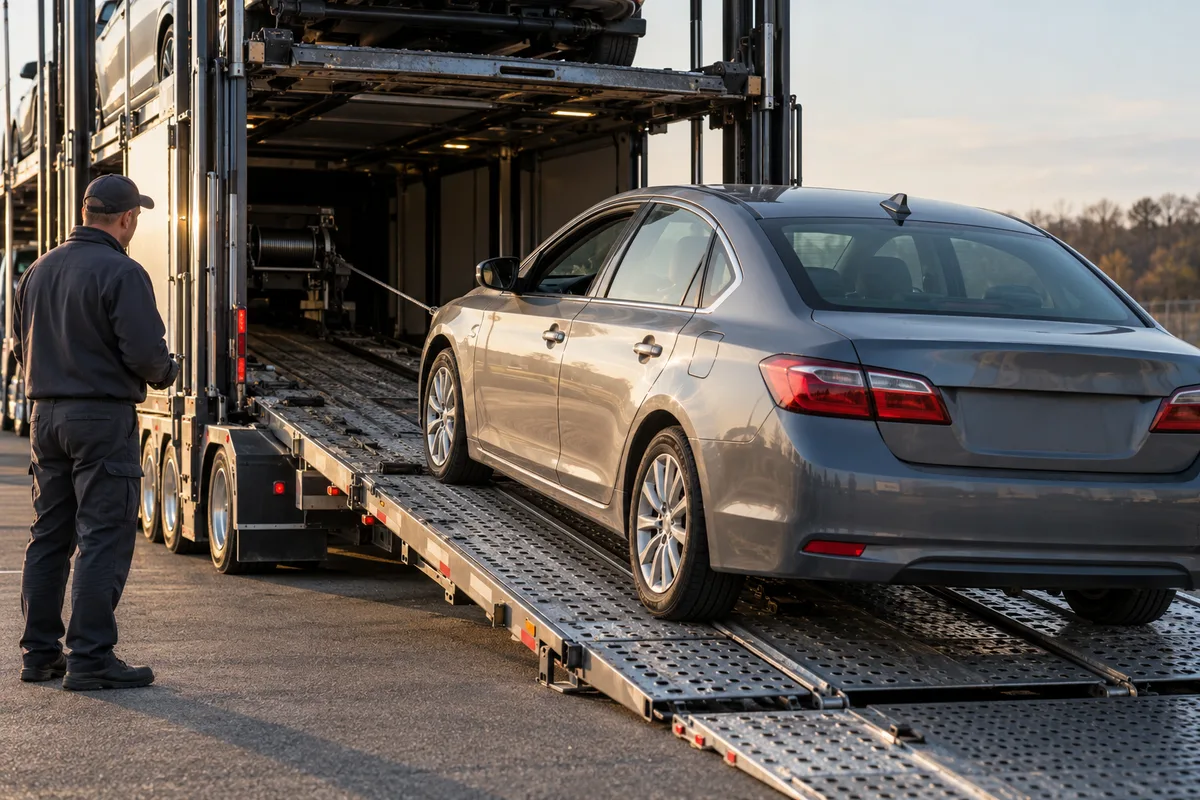
Why winch loading matters when you ship a car
Not every carrier on your route carries a winch, or a driver trained to use one, so a load disclosed as non-running narrows the trucks that can accept it, independent of the price offered for the job. Winch loading matters because it's what makes an inoperable vehicle shippable at all. A vehicle that can't move under its own power has no way onto a trailer deck without it. A dispatcher matching a non-running vehicle to a truck is solving an equipment problem first, and a scheduling problem second.
When winch loading happens during a car shipment
Winch loading happens at pickup, once the assigned carrier arrives and the driver can see your vehicle's actual condition rather than the condition described at booking. A driver expecting a running vehicle who finds one that won't start can still winch it aboard if the wheels turn freely and the truck carries the equipment, but a driver who shows up without a winch for a load that needs one has to leave the vehicle behind or wait for a different truck. The condition you report at booking is what a dispatcher uses to assign the right equipment, so an inaccurate description is what turns a routine pickup into a missed one.
What a vehicle needs for winch loading
Winch loading needs a vehicle whose wheels turn freely enough to roll up the ramp under cable tension, even if the engine won't start or the transmission won't engage. A vehicle whose wheels are seized, missing, or blocked by a locked brake can't be pulled up a ramp by a winch alone, and a carrier facing that condition needs a flatbed body or dolly skates placed under the tires before a winch can do any work at all. Steering has to move too, at least enough to track straight up the ramp centerline, or the vehicle can wander off the edge as the cable pulls it forward.
Winch loading vs liftgate loading
Winch loading and liftgate loading solve two different loading problems, and a single trailer can carry one, both, or neither piece of equipment.
| Winch loading | Liftgate loading |
|---|
| Problem it solves | Vehicle cannot move onto the trailer under its own power | Vehicle can be driven, but its underside cannot clear a standard ramp angle |
|---|
| How the vehicle moves | Cable and powered drum pull the vehicle up the ramp | A hydraulic platform lifts the vehicle level with the trailer deck, then lowers it into place |
|---|
| What the vehicle needs | Wheels and steering that still turn freely enough to be guided up the ramp | Nothing beyond the ability to be driven onto the platform |
|---|
A vehicle can need both a winch and a liftgate on the same pickup, when it can't move under its own power and its underside can't clear a standard ramp angle either, and a carrier missing either piece of equipment may have to decline the load. Published carrier FAQ content names winches and lift gates as separate pieces of equipment for handling an inoperable vehicle, which matches the mechanical distinction above.
Tiedown rules after winch loading
Winch loading and standard drive-on loading get secured to the same federal standard once your vehicle stops moving on the trailer deck. 49 CFR 393.128 requires automobiles, light trucks, and vans carried as cargo to be "restrained at both the front and rear to prevent lateral, forward, rearward, and vertical movement using a minimum of two tiedowns." The same section adds that "tiedowns that are designed to be affixed to the structure of the automobile, light truck, or van must use the mounting points on those vehicles that have been specifically designed for that purpose." A winch pulls your vehicle into position on the trailer deck. Finding those manufacturer-built mounting points is a separate step after the pull, and a vehicle whose factory tie-down points are rusted through, removed, or replaced with an aftermarket part can be harder to secure than it was to winch aboard.