
Ship a Car from Texas to California
Texas to California is a 1,438-mile corridor that carriers run on I-30, I-20 and I-10. Vehicles moving in this distance band run $950 to $1,250 as a reference range.
Texas to California at a glance
| Road distance | 1,438 miles (Dallas, TX to Los Angeles, CA) |
|---|---|
| Drive time, no stops | About 25 hours |
| Wave transit estimate, days | 3–4 |
| Reference range | $950–$1,250 |
| Primary interstates | I-30, I-20 and I-10 |
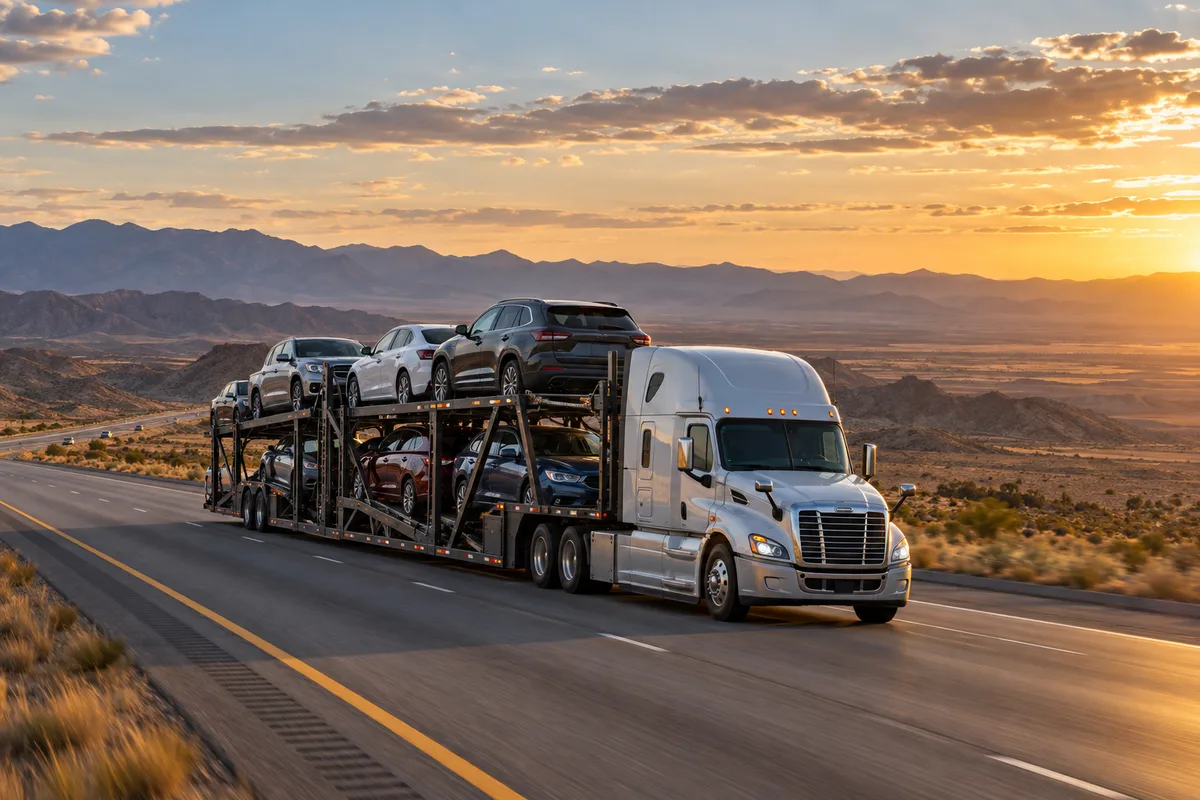
How much does it cost to ship a car from Texas to California?
Vehicles moving in the 1,000–1,500-mile distance band cost $950 to $1,250 as a reference range. A Texas-to-California shipment at 1,438 miles sits inside that band.
That figure is a reference range. It is a general figure, not a price for your car, and no dispatcher has looked at your dates. It is for a running sedan on the open-carrier default. The live, current price for a named vehicle, a real pickup date and two real addresses comes from the quote form. One thing specific to this corridor: a quote for the same two cities in the opposite direction is not the same number.
What you would pay by vehicle type
The $950–$1,250 reference range on this lane is for a standard sedan. Larger vehicles cost more on Texas to California, as on every lane Wave ships, by the same percentages.
| Vehicle type | Against the sedan baseline |
|---|---|
| Sedan / coupe / small car | Reference range: $950–$1,250 |
How long does it take?
Wave estimates 3 to 4 days in transit on this lane, counted from the day a carrier collects the vehicle to the day it is delivered.
Wave's model assumes 550 miles of driving a day, then adds whole days of dispatch and consolidation slack on top: one day on the low end for every full three driving days, and on the high end one day for a short lane or two days for every full five days on the low end. It is our own operating assumption, not a measured fleet average.
Wave estimates 6 to 9 days from booking to delivery on regular service, because the pickup window comes before any of the driving does.
| Service level | Pickup window, days | In transit, days | Total, days |
|---|---|---|---|
| Expedited | 1-2 | 3-4 | 4-6 |
| Regular | 3-5 | 3-4 | 6-9 |
| Flexible | 6-15 | 3-4 | 9-19 |
What route does the truck actually take?
Carriers moving a vehicle from Texas to California take I-30 out of Dallas to Fort Worth, I-20 west across Texas, then I-10 through El Paso and the southern desert into the Los Angeles basin.
I-10 is the spine of this lane, carrying 959 of its 1,438 miles, two thirds of the trip on one road. I-20 covers 421 miles of west Texas before the two meet, and I-30 accounts for the first 44 miles between Dallas and Fort Worth. Both metros on this route are in Texas: Fort Worth about 1 mile from the measured route line and El Paso right on it. That is a feature of the lane, not a gap: the drive from Dallas to the New Mexico line is a long single-state run, and a carrier that fills the deck in Dallas often has no economic reason to stop again until it is well past El Paso. For a shipper the practical read is that a pickup in Houston, San Antonio or El Paso is not simply this lane minus some miles; an El Paso pickup skips the I-30 and I-20 legs entirely and starts on I-10.
| Route | Used for | Interstates | Miles | Named metros |
|---|---|---|---|---|
| Primary route | not named | I-10 959 mi / I-20 421 mi / I-30 44 mi | 1,438 mi | El Paso, TX, Fort Worth, TX |
What is different about this lane?
Texas to California and California to Texas are the same road measured in opposite directions, and Wave publishes them as two separate lanes with their own reference ranges.
The two directions round to the same 1,438 miles. The reference ranges for the two directions are not that close. Direction is a price variable in freight, driven by how much other work is already moving each way, so Wave prices California to Texas as its own lane. If a quote for California to Texas surprises you after reading this page, the direction is the first thing to look at, not the mileage. On transit, by contrast, this lane is ordinary: it and its reverse both carry the same 3-to-4-day transit window as most of Wave's mid-length lanes, so a long-haul price on this corridor comes with a mid-length delivery window rather than a longer one.
Open or enclosed on this route?
Open transport is the usual choice for Texas to California. For this Texas-to-California move, treat the table as planning context rather than a live quote. Choose enclosed service for a Texas-to-California vehicle that needs added protection.
Enclosed transport costs 40–50% more than open, so it is stated here as a percentage rather than a dollar amount. Enclosed earns its cost on this lane for a low-clearance sports car, a show car or a restoration facing 959 miles of I-10 desert crosswind and grit. For a commuter car with existing stone chips, open transport is the sensible default and the one most Texas-to-California shippers choose.
How to book, step by step
Booking a Texas-to-California car shipment begins with a quote request and ending with a signed bill of lading at delivery.
- 01
- 02
- 03
- 04
- 05
Frequently asked questions about shipping Texas to California
- How much does it cost to ship a car from Texas to California?
Car shipping in the 1,000–1,500-mile band runs $950 to $1,250 as an open-trailer reference range. A Texas-to-California shipment at 1,438 miles falls inside that band. This is a reference price range for this distance band, not a quote for your shipment. Your actual rate varies depending on: vehicle details, the specific pickup location, the delivery location, the timing of pickup and delivery, any additional services, driver availability, and other market conditions.
- How long does it take to ship a car from Texas to California?
Wave estimates 3 to 4 days in transit on this lane, counted from the day a carrier collects the vehicle to the day it is delivered.
- What is the driving distance from Texas to California?
The road distance from Dallas, TX to Los Angeles, CA is 1,438 miles, computed on the OpenStreetMap road network and published under ODbL. Wave measures the reverse direction separately, and it also rounds to 1,438 miles. A pickup in El Paso instead of Dallas removes the entire I-30 and I-20 portion of the route and starts the trip on I-10.
- Why does shipping California to Texas cost a different amount than Texas to California?
Direction is a real price variable on the Texas-to-California corridor, because carriers price against how much freight is already moving each way, not against mileage alone. Wave treats California to Texas as its own lane rather than blending the two directions into one figure. Direction is worth asking about when a quote surprises you.
- Can I book enclosed transport from Texas to California?
Yes. Enclosed transport is available on any lane Wave Auto Transport books, including Texas to California. Enclosed transport typically costs 40% to 50% more than open transport. A live quote returns the current enclosed price.
- Which highways do carriers use between Texas and California?
Carriers running Texas to California use I-30 for the first 44 miles from Dallas to Fort Worth, I-20 for 421 miles across west Texas, and I-10 for 959 miles through El Paso, southern New Mexico and Arizona into the Los Angeles basin. Both metros on this route, Fort Worth and El Paso, are in Texas, which is why so much of the trip happens before the truck leaves the first state.
- Will a carrier deliver directly to my driveway in Los Angeles?
Usually not for the last few blocks. The Texas end of this lane rarely causes trouble, but Los Angeles delivery does: hillside streets, tight switchbacks above Silver Lake and Echo Park, older narrow blocks with parked cars on both sides, and condo garages with a posted clearance bar are all places a full-length carrier physically cannot go. The driver calls ahead and meets at a wide street or a large parking lot nearby, which is a normal part of the job.
- How fast can a truck pick the car up in Texas?
Wave estimates 3 to 4 days in transit on this lane, counted from the day a carrier collects the vehicle to the day it is delivered.
Related routes
| Route | Why it is related |
|---|---|
| California to Texas car shipping | The reverse of this lane, measured separately and priced as its own record |
| Texas to Florida car shipping | Shares Texas as an endpoint state and the I-10 and I-20 corridor |
| Texas to Arizona car shipping | Shares Texas as an endpoint state and part of the same westbound corridor |
| California to Arizona car shipping | Shares California as an endpoint state and the I-10 approach into the Los Angeles basin |
| New York to California car shipping | Shares California as an endpoint state and is the longest lane on this site |