
California Car Shipping
Getting a car to California, or out of it, means trusting someone else to drive it. We arrange that: a vetted carrier handles the move. We publish distances and reference prices for 9 California routes. Registering the car once it lands is on you, and we have no part in that.
Published California routes
California car shipping routes, with each route's distance and reference price range. These are reference ranges, not quotes.
| Route | State role | Road miles | Distance band | Reference range for that band |
|---|---|---|---|---|
| California to Nevada car shipping | California origin | 269 miles | 0–500 miles | $350–$600 |
| California to Arizona car shipping | California origin | 373 miles | 0–500 miles | $425–$725 |
| California to Oregon car shipping | California origin | 962 miles | 500–1000 miles | $725–$1,150 |
| California to Washington car shipping | California origin | 1,135 miles | 1000–1500 miles | $800–$1,100 |
| Texas to California car shipping | California destination | 1,438 miles | 1000–1500 miles | $950–$1,250 |
| California to Texas car shipping | California origin | 1,438 miles | 1000–1500 miles | $925–$1,250 |
| California to Georgia car shipping | California origin | 2,176 miles | 2000–2500 miles | $1,025–$1,475 |
| California to Florida car shipping | California origin | 2,732 miles | 2500–3000 miles | $1,300–$1,750 |
| New York to California car shipping | California destination | 2,794 miles | 2500–3000 miles | $1,175–$1,650 |
How California appears in these routes
We publish California as an origin on 7 routes and as a destination on 2.
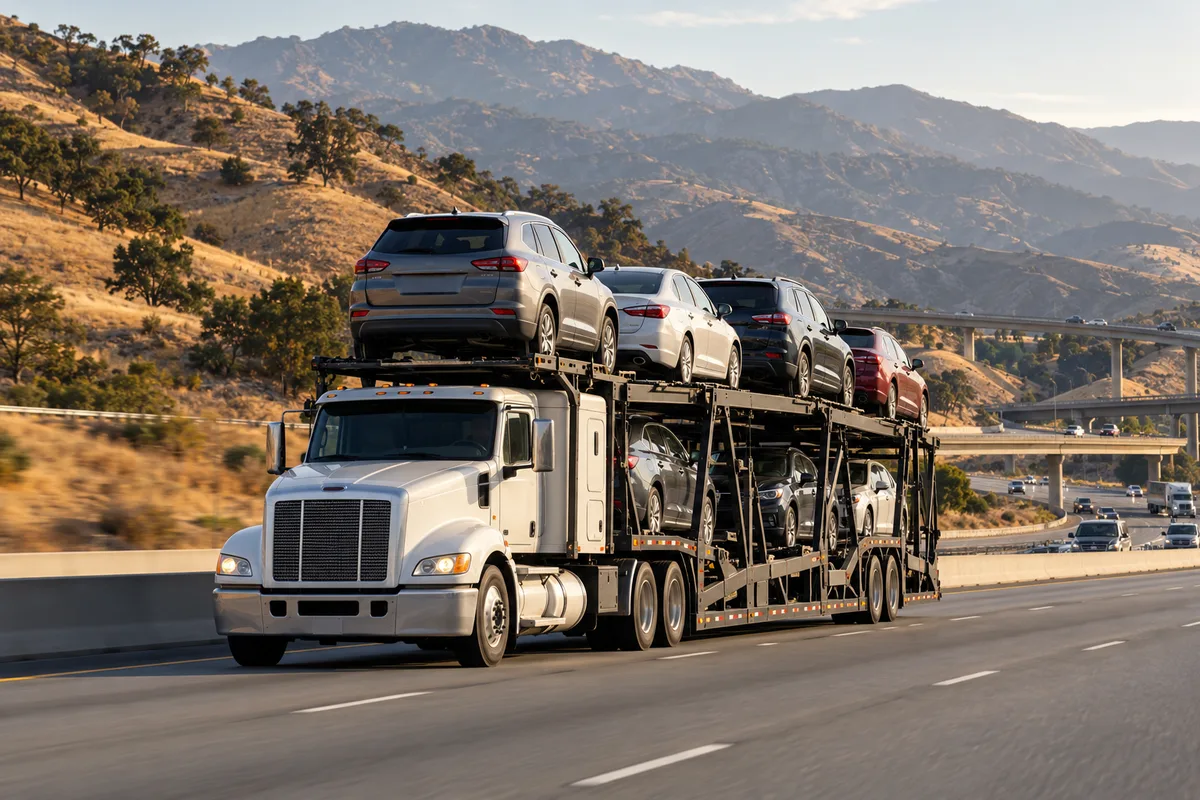
How much does it cost to ship a car to or from California?
What you pay to ship a car in California depends on where the other end of the trip is. California's own routes span five different price bands, more than any other state we publish.
We don't price a state, because a price needs two endpoints and a state only has one. California shows why that matters: a car going from Los Angeles to Las Vegas and a car going from Los Angeles to Miami leave the same curb and land in completely different price bands. Every figure on this page is a reference range for a distance band. This is a reference price range for this distance band, not a quote for your shipment. Your actual rate varies depending on: vehicle details, the specific pickup location, the delivery location, the timing of pickup and delivery, any additional services, driver availability, and other market conditions. Want your real number? Get a quote.
Who handles registration and inspection paperwork for a car shipped to California?
Registering your car, getting it inspected, or getting a VIN check done in California is up to you. We don't handle any of it.
We arrange the carrier and the move. What happens to your car once it's off the truck is yours to handle: registration, inspection, anything California's own Department of Motor Vehicles requires from a new or returning owner. We don't walk you through California's rules, inspect anything, or file paperwork on your behalf.
Which California routes do we cover?
We publish reference ranges for nine California routes, more than any other state, and cars leave California far more often than they arrive on those routes.
Cars leave California for Texas, Florida, Arizona, Nevada, Washington, Georgia and Oregon on our published routes. Only two published routes run the other way, into California. That reflects which pages we've built, not proof of which direction trucks drive, but it does line up with the corridor: the long haul into Los Angeles is often the leg a carrier still needs to fill, and the haul back out is often already booked. Each route in the table links to its own page, with that route's distance, reference price range and transit time.
What route does the truck take on the California-to-Texas run?
Ship a car from Los Angeles to Dallas and it spends 959 of its 1,438 road miles on one highway, I-10, crossing the desert Southwest through El Paso before I-20 and I-30 finish the job into Dallas-Fort Worth.
It's a southern-tier route with almost no elevation and no winter closures, which is part of why it's the busiest lane out of California in our published set. The shorter Los Angeles-to-Phoenix run starts the same way: 360 of its 373 road miles are also on I-10, through Palm Springs and Blythe. A carrier loading for Phoenix and a carrier loading for Dallas leave Los Angeles on the same highway and split apart hundreds of miles later. That is why a short Southwest run is often the filler load on someone else's longer trip, not a trip of its own. Every California figure on this page is measured from Los Angeles. Pick up anywhere else in the state and you're covering a different number of miles than the one published here.
What time of year affects a car shipment to or from California?
California lets studded tires on from November 1 to April 30 under state law, but there's no calendar for chain controls. Caltrans posts those against the weather, not the date.
The second fact matters more to a car carrier than the first. Caltrans sets no fixed date for chains. Controls go up when the weather calls for it and come down when it clears. Once one's posted, every heavy-duty vehicle over 6,500 pounds needs chains mounted to proceed, with no exception for tire type, and any vehicle towing a trailer needs them, full stop. A loaded car carrier is both of those things. A carrier with chains keeps moving through a chain control. A carrier without them is stopped. Studs come off between May 1 and October 31, emergency vehicles excepted year-round. We can't name a busiest or cheapest month for California because we have no California shipment-volume record to base one on.
Source: California Vehicle Code section 27454 - California Legislative Information · checked
Additional source: Truck Chain Requirements - Caltrans
Does Wave Auto Transport ship cars to California?
Yes. We arrange car shipping into and out of California as a broker, and every move goes to a vetted, licensed, insured carrier in our network.
We have no office, terminal or yard in California, and nobody on the ground there. We book the job, match the carrier and dispatch it. Door-to-door means the driver gets as close to your address as a full-size carrier can legally and safely get. A seventy-five-foot rig can't get up into the Hollywood Hills, along the hillside streets of Silver Lake and Echo Park, into the tight grids of San Francisco's Telegraph Hill and Russian Hill, or down most of the older blocks of Santa Monica and West Hollywood. On streets like that, the driver meets you in a wide lot or on a flat street nearby. That is the normal outcome there, not a booking failure.
Where does California sit in Wave's own shipping network?
California-to-Northeast is one of our four highest-volume corridors. On this site, that's the New York-California route, the longest one we publish for the state.
California isn't part of our snowbird pattern, which runs the Northeast, northern Illinois, Maryland, and Virginia into Florida, Arizona, and Texas. California sits outside that flow in both directions. It has its own high-volume corridor to and from the Northeast, separate from the seasonal snowbird traffic. It's also the state with the most routes we publish: seven leaving and two arriving, more of both than anywhere else on our site.
What car-auction infrastructure sits in California?
We regularly pick up from and deliver to two California auction locations: ADESA Los Angeles in Mira Loma, out in the Inland Empire, and Manheim San Francisco Bay in Hayward, up north.
They're far enough apart to serve two different markets, Southern and Northern California, instead of competing for the same dealers. We have no agreement with either auction house. We pick up from and deliver to auctions like these regularly, and we work around their schedule. Neither location changes what the transport costs. It's priced the same as any other open or enclosed shipment on California's routes.
Where California's shipping volume sits
Every published California route on this page is measured from one place: Los Angeles-Long Beach-Anaheim, 12,927,614 people, ranked 2 in the country.
Los Angeles is the anchor city we measure from. We arrange shipping from anywhere in California, not only from there. California has seven of the country's fifty largest metro areas: Los Angeles, Riverside, San Francisco, San Diego, Sacramento, San Jose, and Fresno. That's more than any other state, by a wide margin. Pick up in San Francisco or Sacramento and you join the corridor hundreds of miles north of the anchor, covering fewer miles than the published figure. Pick up in San Diego and you're adding distance on an eastbound run. Five California towns sit right on our own published corridors: Palm Springs, Blythe, Barstow, Sacramento, and Redding. That means a California pickup is more often on the way to somewhere than out of the way.
Source: U.S. Census Bureau, Population Estimates Program, Vintage 2024, cbsa-est2024-alldata.csv
California car shipping FAQs
- Who handles registration and inspection for a car shipped into California?
- You do, always. We arrange the carrier and the move. We don't register, inspect, or VIN-check anything once your car is off the truck. We won't walk you through California's rules and we won't file paperwork for you.
- Which metro is California's shipping distance measured from?
- Los Angeles. Every published California route on this page is measured from the Los Angeles-Long Beach-Anaheim metro area. California-to-Texas is measured Los Angeles to Dallas, and California-to-Arizona Los Angeles to Phoenix. We still pick up and deliver anywhere in the state. Los Angeles is the measuring point, not a coverage limit.
- Is California one of Wave's highest-volume corridors?
- California-to-Northeast movement is. It's not one of our snowbird corridors, which run the Northeast, northern Illinois, Maryland, and Virginia into Florida, Arizona, and Texas. It is a high-volume corridor in its own right, and it's why the New York-California route exists on this site.
- Can winter weather stop a car delivery in California?
- Yes, on mountain routes. When Caltrans posts a chain control, every heavy-duty vehicle over 6,500 pounds needs chains mounted to proceed, and any vehicle towing a trailer always needs them. A loaded car carrier is both. There's no fixed date for these. Caltrans posts them against the weather, not a calendar.
- Can a car carrier reach my street in Los Angeles or San Francisco?
- Often not directly. A full-size carrier runs about seventy-five feet, and the Hollywood Hills, the hillside streets of Silver Lake and Echo Park, and San Francisco's Telegraph Hill and Russian Hill are too narrow, too steep, or too tightly parked for one. Your driver will call ahead and meet you in a wide lot or on a flat street nearby. That's what door-to-door actually means on a street like that.
- What car-auction infrastructure does California have?
- Two auction locations we regularly pick up from and deliver to: ADESA Los Angeles in Mira Loma and Manheim San Francisco Bay in Hayward. We have no agreement with either auction house. We just work them regularly and fit our pickups around their schedule.
Get a current quote for your exact endpoints
Reference ranges explain the market. The live quote uses your vehicle, pickup, delivery, timing, and requested service.