What is dealer auto transport and who is it for?
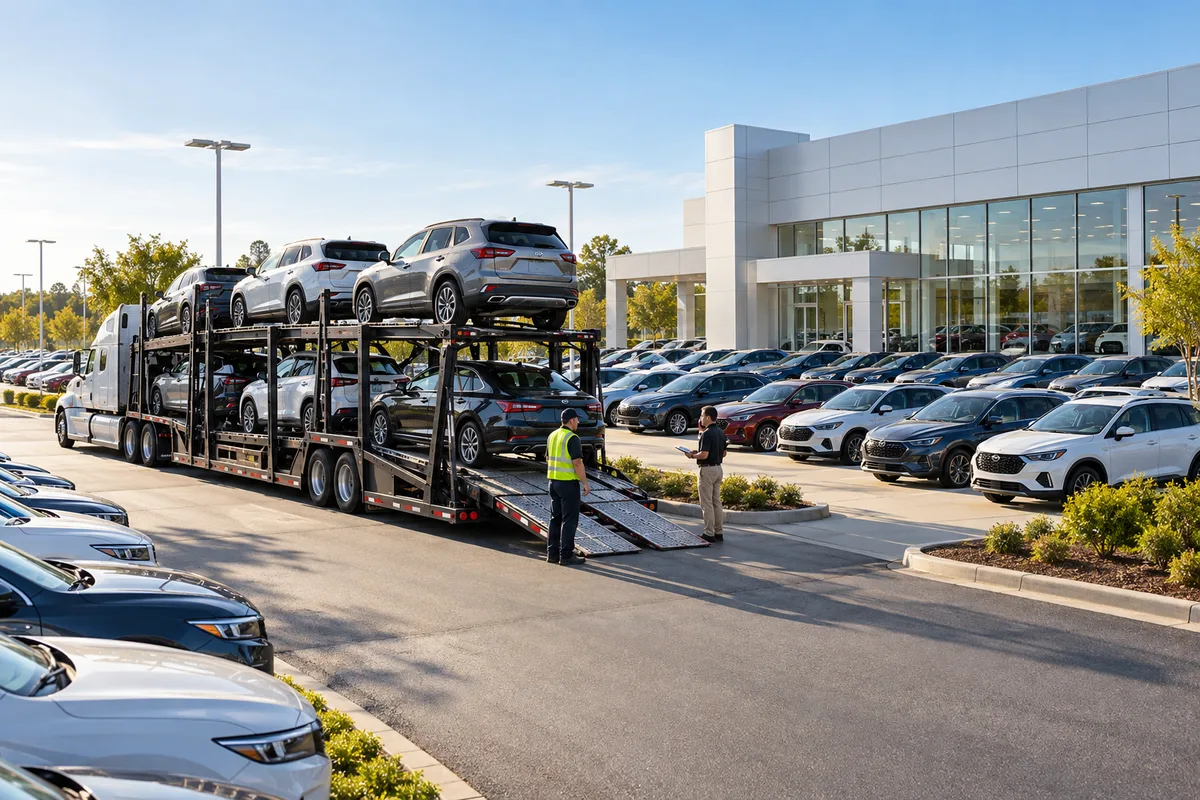
Dealer auto transport is how Wave Auto Transport moves a dealership's inventory: dealer trades between stores, auction buys, cars sold to buyers in other states, and units moving between your rooftops or to storage. Each dealer account gets volume pricing and its own portal.
A dealer trade starts on another dealer's lot. An auction buy starts at the auction gate, once the auction has released the car to you. A customer delivery starts on your lot and ends at your buyer's address. Inventory transport between your own stores, or to and from an off-site storage lot, is the fourth kind of move. We arrange all four as a broker: we book your vehicle with a carrier, check before dispatch that the carrier's equipment and registrations are in order, and the carrier hauls it. We don't own trucks.
Wave delivers within the continental United States only, so a car sold to a buyer in Hawaii, Alaska, Puerto Rico or another country is outside what we move. Title, registration and any other paperwork for the sale stay with you and your buyer.
Dealerships, and the used-car, inventory and transport managers who book their moves.
- Auction car shipping
- Wholesale vehicle transport
- Exporter vehicle transport
- Multi-location dealership transport
How do dealer trades, auction pickups and customer deliveries differ?
Wave's four dealer jobs differ in where the car is picked up, what we need from you, and who signs at delivery.
| Job | Pickup | What we need from you | Who signs at delivery |
|---|---|---|---|
| Dealer trade | The other store's lot | VIN, both store addresses, a contact at each lot | Someone at the receiving store |
| Auction pickup | The auction lot, once the auction has released the car to you | VIN, lot number, buyer or member number, gate pass | Someone at your store, or wherever you send it |
| Out-of-state customer delivery | Your lot | Your buyer's address and a contact for delivery day | Your buyer, or someone your buyer names |
| Store-to-store or storage move | Any of your stores, or an off-site storage lot | Both addresses and receiving hours at each | Someone at the receiving location |
What does dealer auto transport cost?
Dealership car shipping with Wave Auto Transport is priced like any Wave shipment, by distance, vehicle and open or enclosed service, and each dealer account gets volume pricing.
Your price for each shipment comes from a live quote. The quote moves with the vehicle, the pickup and delivery locations, the pickup and delivery timing, any extra services and driver availability. A non-running unit costs more to load, and enclosed transport costs more than open. Reference ranges by distance are on how much does it cost to ship a car, and on the open and enclosed car shipping pages.
How does billing work, and what do you see along the way?
We set up invoicing with your dealer account; ask us about it when you open the account.
Each dealer account gets its own portal to handle your transactions, monitor your shipments and see their status.
How does a dealer shipment move, from booking to invoice?
You send us the job, we book a carrier we have checked, the carrier picks up and delivers the vehicle with a signed bill of lading at each end, and we invoice your account.
- 01
- 02
- 03
- 04
- 05
- 06
- 07
Dealer account vs. a one-time retail shipment
A Wave dealer account differs from a one-time retail shipment in how you are priced and billed, what you send us, where you follow the job, and the auction gate pass.
| Feature | Dealer account | Retail shipment |
|---|---|---|
| Pricing | Volume pricing. | Priced per shipment from a live quote. |
| Payment | Invoiced to your dealer account | No upfront deposit; a deposit is charged once a truck is assigned and dispatched. |
| Job intake | Auction lot and buyer numbers, trade VINs or a buyer's delivery address, often several units at a time. | One vehicle, one pickup address, one delivery address. |
| Where you watch the job | Your own dealer portal, showing your transactions, your shipments and their status. | A customer portal that shows live location when the driver shares it. |
| Auction gate pass | You provide the pass; we keep it with your booking and give it to the assigned driver after dispatch. | Doesn't apply to a home pickup. |
When dealer auto transport is NOT the right fit
If you buy or trade cars on behalf of several dealers, wholesale vehicle transport is the closer match, and if you are an HR team moving an employee's own car, use corporate relocation car shipping.
A Wave dealer account is set up around your own inventory: trades, auction buys, customer deliveries and moves between your stores, billed to your dealership. A wholesaler moves inventory for different customers and can have billing combined or kept separate. An exporter needs cars delivered to a port or a shipping company's yard. A rental or corporate fleet has its own page, and one personal car needs only a standard quote.
What we do and don't do for dealers
Wave Auto Transport is a broker: we arrange your dealer shipments and dispatch them to carriers we have checked, and those carriers run the trucks.
How should a dealership choose a car transporter?
A dealership should choose a car transporter by confirming whether it is hiring a broker or a carrier, checking the company's federal registration, and asking in writing who holds the cargo coverage, who handles damage and what the pickup window is.
Searches for car dealership transporters mix two different buyers: the dealer who wants a company to move cars, and the trucker who wants dealer loads. This section is for the dealer. Wave Auto Transport is a licensed property broker (USDOT 2962521, MC-5573), so the questions below are the ones we would want a dealership to ask us.
Broker or carrier: what is a dealer actually hiring?
A dealer hires a broker to arrange the move and a carrier to drive it; Wave Auto Transport is a broker, and the carrier assigned to your shipment owns the truck and holds the cargo coverage.
A carrier owns trucks and employs the drivers. A broker holds no trucks. It books each vehicle with a carrier, handles the paperwork and is the dealer's point of contact. The difference decides who answers when something goes wrong. With a broker, the dealer talks to one company, and the broker deals with the carrier. When a dealer posts a load directly to a self-serve platform or hires a carrier directly, the dealer is the one finding the carrier, reading the carrier's paperwork and settling any dispute with it. Neither model is better for every dealer. A store with a full-time logistics person may like the control. A store without one may prefer to hand the work to a broker. Wave may subcontract a shipment to a carrier, and a claim is filed with the carrier named on the bill of lading.
| Question | Broker | Carrier |
|---|---|---|
| Who owns the truck? | No one at the broker; it owns no trucks. | The carrier. |
| Who do you contract with? | The broker, which books the carrier. | The carrier directly. |
| Who holds the cargo coverage? | The carrier assigned to the shipment. | The carrier. |
| Who runs a damage dispute? | At Wave, Wave runs it among the dealer, the carrier and the insurer. | The dealer deals with the carrier and its insurer. |
What should a dealership verify before the first load?
Before the first load, a dealership should verify the company's USDOT and MC numbers on the federal safety site, confirm the authority is active, and ask what the company checks about the carrier before dispatch.
Any transporter's registration can be looked up for free on the Federal Motor Carrier Safety Administration's SAFER system, and Wave Auto Transport's own USDOT and MC numbers are on that record for you to check. The steps are laid out on the verification guide. Then ask a question the registry cannot answer: what does the company check about the carrier it books? At Wave, equipment and registrations are checked before dispatch, and the cargo coverage is confirmed to be active. Ask any transporter for the same detail in writing. Be wary of an answer that is only an adjective such as vetted or trusted.
How is damage handled on a dealer unit?
If a dealer unit arrives damaged, the person receiving it writes the damage on the bill of lading before signing, and Wave Auto Transport runs the dispute among the dealer, the carrier and the insurance company and helps the dealer get paid.
The claim itself is paid by the carrier or its cargo insurer, and Wave does not pay it. A written claim goes to Wave and the carrier within 15 days of delivery, with the photos taken at the lot. For a dealer, the practical point is to train whoever receives units to inspect before signing, because a signature on a clean bill of lading makes a later claim harder. That is the same at every transporter.
What pickup window can a dealer expect?
A dealer can choose a pickup window of 1 to 2 days (expedited), 3 to 5 days (regular) or 6 to 15 days (flexible), with a guaranteed pickup window at a premium, and no transporter should promise a delivery date.
Match the window to the unit. A sold car with a buyer waiting suits expedited. A trade between stores with no deadline suits flexible, which is typically the lowest-cost window. When you compare transporters, ask whether a stated pickup pace is a typical figure or a commitment, and whether a delivery date is promised. At Wave, delivery dates are estimates at every level.
Explore Wave's dealer and auction programs
Wave's programs for the dealer side of the market are auction car shipping for dealers and other auction buyers, wholesale vehicle transport, exporter vehicle transport and fleet vehicle transport, each written for a different buyer.
Dealer auto transport FAQs
- Do you ship cars for dealerships?
Yes, Wave Auto Transport ships cars for dealerships: dealer trades, auction pickups, deliveries to out-of-state buyers, and moves between your stores or to storage. Wave is a broker, so each vehicle rides with a carrier whose equipment and registrations we check before dispatch. Wholesalers who buy for several dealers, and exporters sending cars to a port, have their own pages.
- Can you pick up a car I bought at Manheim, ADESA, Copart or IAAI?
Yes, Wave picks up from and delivers to Manheim, ADESA, Copart and IAAI locations regularly, and we work around each auction's own schedule. To book the pickup, send us the VIN, the auction's lot number and your buyer or member number. Once you have your gate pass, send that too; we keep it with your booking and give it to the assigned driver after dispatch.
- How fast can you pick up a vehicle after I win it at auction?
Wave typically gets a truck to the auction gate within 24 to 48 hours of your win. That is a typical pace and not a guarantee: the auction has to release the car first, and carrier availability on your route sets the final window, which dispatch confirms after you book.
- Do you handle dealer trades between stores?
Yes, Wave handles dealer trade transport in both directions, from the other store's lot to yours or from yours to theirs. Someone at each store releases or receives the car and signs the bill of lading.
- Can you deliver a car I sold to a customer in another state?
Yes, Wave delivers cars sold to out-of-state buyers anywhere in the continental United States, door to door most of the time. Your buyer, or someone your buyer names, meets the driver, checks the car and signs the bill of lading. Title, registration and any other paperwork for the sale stay with you and your buyer.
- Is there a dealer portal, and what does it do?
Yes, each Wave dealer account gets its own portal, where you handle your transactions, monitor your shipments and see their status.
- Do dealers get volume pricing?
Yes, Wave offers dealers volume pricing. Each shipment is still priced by a live quote, which moves with the vehicle, the pickup and delivery locations, the timing, any extra services and driver availability.
- When is payment due on a dealer account?
We invoice dealer accounts. Ask us about invoicing when you open your account.
- What pickup windows can I choose, and can you guarantee a date?
Wave offers three pickup windows: expedited, 1 to 2 days after booking; regular, 3 to 5 days; and flexible, 6 to 15 days. A guaranteed pickup window is available for an extra charge. Wave does not guarantee a delivery date at any service level, and pickup and delivery dates are estimates.
- Who inspects the vehicle and signs the bill of lading?
The driver inspects the vehicle at pickup and records its condition on the bill of lading, and on a dealer lot someone from that store releases the car and signs. At delivery, the person receiving the car, at your store or at your buyer's address, checks it against the pickup notes, writes any new damage on the bill of lading and signs.
- What happens if a vehicle arrives damaged?
Write the damage on the bill of lading before you sign at delivery, take photos, and send a written claim to Wave and to the carrier. Wave handles the dispute between you, the carrier and the insurance company. Cargo coverage on the shipment is the carrier's, and we check that it is active before dispatch.
- Can you move non-running or high-value inventory?
Yes, Wave moves any vehicle on your lot. Non-running units need a carrier with a winch and cost more to load. High-value, classic or exotic inventory can ship enclosed on a hardside trailer, which costs more than open transport.
Last checked