What counts as a commercial vehicle for car shipping?
A commercial vehicle for car shipping is a cargo van, passenger van, work pickup, upfitted pickup or light service truck that a business owns or uses for work. Wave Auto Transport arranges transport for these vehicles anywhere in the continental United States.
The phrase commercial vehicle transport carries two meanings, and this page answers both in separate sections. The first meaning is the vehicle: a van with shelving, a pickup with a utility body, a service truck with a toolbox. The second meaning is the customer: a business, a contractor or a company that needs a vehicle moved and wants an invoice instead of a personal card payment. A plumber relocating a service van to a new branch is both at once. A retiree moving a personal pickup is only the first, and a company moving an employee's sedan is only the second. Wave Auto Transport is a licensed property broker. We book each vehicle with a carrier, check before dispatch that the carrier's equipment and registrations are in order, and the carrier hauls the vehicle. We do not own trucks. We move vehicles within the continental United States only, so a van headed to Alaska, Hawaii or another country is outside what we arrange.
Will a cargo van or high-roof van fit on a car carrier?
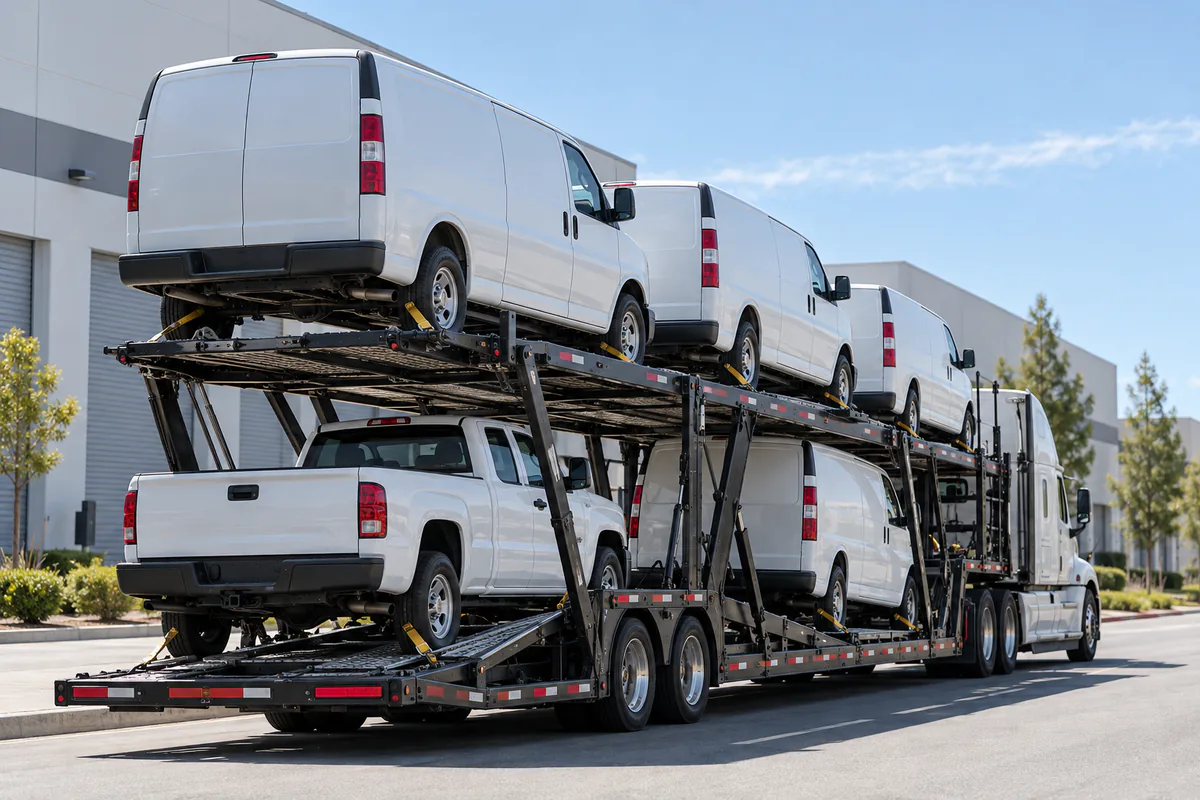
A cargo van fits on a car carrier when its height, length and weight are within what the assigned carrier's trailer can take, and the quote form asks for those dimensions because the carrier's equipment, not the van's badge, sets the limit.
A standard cargo van is much taller than a sedan, and a high-roof van is taller again. Height is the first question a dispatcher asks, because a van that is too tall for a given trailer cannot be loaded on it, however well the van runs. Weight is the second question. A van carrying a built-in shelving system or a heavy upfit weighs more than the same van empty. Wave publishes no carrier height or weight limit, because the limit belongs to each carrier's trailer and varies from one carrier to the next. Give the exact height, length and weight on the quote form, and say if the van is a dual-rear-wheel model. That information lets dispatch look for a carrier whose equipment fits before any truck is assigned, instead of discovering the problem at the curb on pickup day. A deposit is charged only after a truck has been assigned and dispatched.
Do ladder racks, shelving or a service body change the move?
Yes. A ladder rack, roof cargo carrier, shelving or a service body changes the vehicle's height, length or weight, and any of those three can change which carrier can take the job and what the live quote says.
Three things about an upfit matter to a car carrier. The first is dimensions: a ladder rack adds height, and a utility body or a long-bed work pickup with a ladder rack adds length and height together. The second is weight, since built-in storage and tooling add mass. The third is what is attached to the outside, because racks, lights and antennas can contact a trailer deck or another vehicle if they are not described in advance. Tell the quote form what is bolted on, and remove what comes off. Ladders, loose tools, parts and stock should not ride inside the vehicle. Under the customer contract, the customer removes personal belongings and contents, Wave may charge extra for contents left in, and Wave is never responsible for them. A work van is the vehicle most likely to be full of valuable property, so this rule matters more here than on a sedan. Photo the vehicle on all sides before pickup, including the upfit. The driver records condition on the bill of lading at pickup, and the same document is checked at delivery.
Which commercial situations does Wave Auto Transport arrange?
Wave Auto Transport arranges transport for four commercial situations: a business moving its own work vehicle, a fleet or rental repositioning, a dealer moving inventory, and a company moving an employee's personal vehicle.
| Situation | What is being moved | Where to read the detail |
|---|---|---|
| A business moves one or a few work vehicles | A cargo van, work pickup or service truck, picked up from a shop, yard or home | The sections on this page about vans, upfits and cost |
| A fleet or rental company repositions vehicles | Several vehicles, often from a depot or return lot | Fleet vehicle transport |
| A dealership moves inventory | Trades, auction buys, customer deliveries, store-to-store moves | Dealer auto transport |
| A company relocates an employee | The employee's personal car, on the company's account | Corporate relocation car shipping |
Can a business ship one vehicle, or does it need a fleet account?
A business can ship a single vehicle with a standard quote, and it does not need a fleet account to do so. A fleet page applies when many vehicles move under one manager.
One van moving between two branches is a standard shipment: the quote form, a live quote, a pickup window and a carrier. A contractor with three trucks moving in the same week can submit each vehicle and ask about invoicing. Wave Auto Transport does the transportation and then invoices business accounts. If the vehicles belong to a rental or corporate fleet, read fleet vehicle transport. If a dealership is moving inventory, read dealer auto transport. Each of those pages describes a different buyer with different paperwork.
What changes the price of shipping a commercial vehicle?
The live quote for a commercial vehicle moves with the vehicle's size and weight, the distance, whether the vehicle runs, open or enclosed service, the pickup window, and driver availability on the lane.
Wave Auto Transport publishes no commercial-vehicle price range, and the price for your shipment comes only from a live quote. Larger and heavier vehicles cost more than a car. An oversized vehicle is priced individually, so tell the quote form its dimensions. Enclosed service costs 40 to 50 percent more than open, and it is worth considering for a freshly wrapped or branded van whose paint and graphics matter to the business. A flexible pickup window is usually the lowest-cost option. The general reference ranges for cars, which do not apply to vans and work trucks, are on how much it costs to ship a car. Use them only to see how distance moves a price, then get a live quote for the actual vehicle.
How does a commercial vehicle shipment work, step by step?
A commercial vehicle shipment runs in six steps: quote, pickup window, carrier match, pickup with a bill of lading, transit, and delivery with a signed inspection.
- 01
- 02
- 03
- 04
- 05
- 06
Can a car carrier reach a shop, yard or job site?
A carrier reaches a commercial address when the driver can get in and out safely without damaging the truck, the vehicle or other property. When the address does not allow that, the driver meets the customer nearby.
A commercial pickup point is often harder for a full-size carrier than a home: a loading dock with a low canopy, an industrial park with a tight turn, a yard with overhead wires or a shop on a one-way street. Wave Auto Transport applies the same door-access rule everywhere. The service goes to the address, and where physics does not allow it, the driver arranges a meeting point with room to load, such as a large parking lot a short distance away. For a work vehicle that cannot be driven to the meeting point because it does not run, say so on the quote form. A non-running vehicle needs a carrier with a winch, and the move costs more than for a running one.
What commercial vehicles can Wave Auto Transport not move?
Wave Auto Transport does not ship box trucks, step vans, semi trucks or heavy equipment, so an owner of one of those needs a different transporter. It also does not move vehicles outside the continental United States.
Drive-away service means a driver drives the vehicle to its destination, and Wave Auto Transport does not offer it. A van or truck that is too tall, too long or too heavy for the assigned carrier's trailer therefore cannot be moved by driving it. Enter the exact dimensions and weight on the quote form, and dispatch will look for a carrier whose equipment fits before any truck is assigned. Wave Auto Transport moves vehicles within the continental United States only.
What we do and don't do for commercial vehicles
Wave Auto Transport is a broker: we arrange commercial vehicle shipments and dispatch them to carriers whose equipment and registrations we check, and those carriers haul the vehicles.
Commercial vehicle transport FAQs
- Can you ship a cargo van?
Yes, Wave Auto Transport arranges transport for cargo vans, subject to the van's height, length and weight fitting the assigned carrier's trailer. Enter the exact dimensions on the quote form so dispatch can look for a carrier whose equipment fits.
- Can you ship a work truck with a ladder rack or utility body?
Yes, Wave Auto Transport arranges transport for work pickups and upfitted trucks. A ladder rack, utility body or roof carrier changes the height, length or weight, so describe every addition on the quote form.
- How much does it cost to ship a commercial vehicle?
The price comes from a live quote, and it moves with the vehicle's size and weight, the distance, whether it runs, open or enclosed service, the pickup window and driver availability. Enclosed service costs 40 to 50 percent more than open.
- Can a business be invoiced instead of paying by card?
Yes, Wave Auto Transport does the transportation and then invoices business accounts.
- Do I need to empty the van before pickup?
Yes. The customer removes tools, stock and personal belongings before pickup. Wave may charge extra for contents left in the vehicle and is never responsible for them.
- What happens if the commercial vehicle arrives damaged?
Write the damage on the bill of lading before you sign at delivery, take photos, and send a written claim to Wave and the carrier within 15 days of delivery. Wave handles the dispute between the customer, the carrier and the insurance company. Cargo coverage is the carrier's.
Last checked