
Bill of Lading in Auto Transport
Your bill of lading is the document your damage claim gets judged against. It is the receipt the carrier issues for your car at pickup, and on most shipments it doubles as your condition report: the same sheet where you and the driver mark existing damage before the car is loaded. You sign it twice, once at pickup and once at delivery.
What happens at pickup - the walkaround, step by step
Pickup follows a fixed sequence: the driver arrives, you walk the vehicle and the bill of lading together, existing damage gets marked on the sheet, both of you sign, and only then does your car go onto the carrier.
- You, or your authorized representative, meet the driver at the pickup location with your vehicle and the bill of lading.
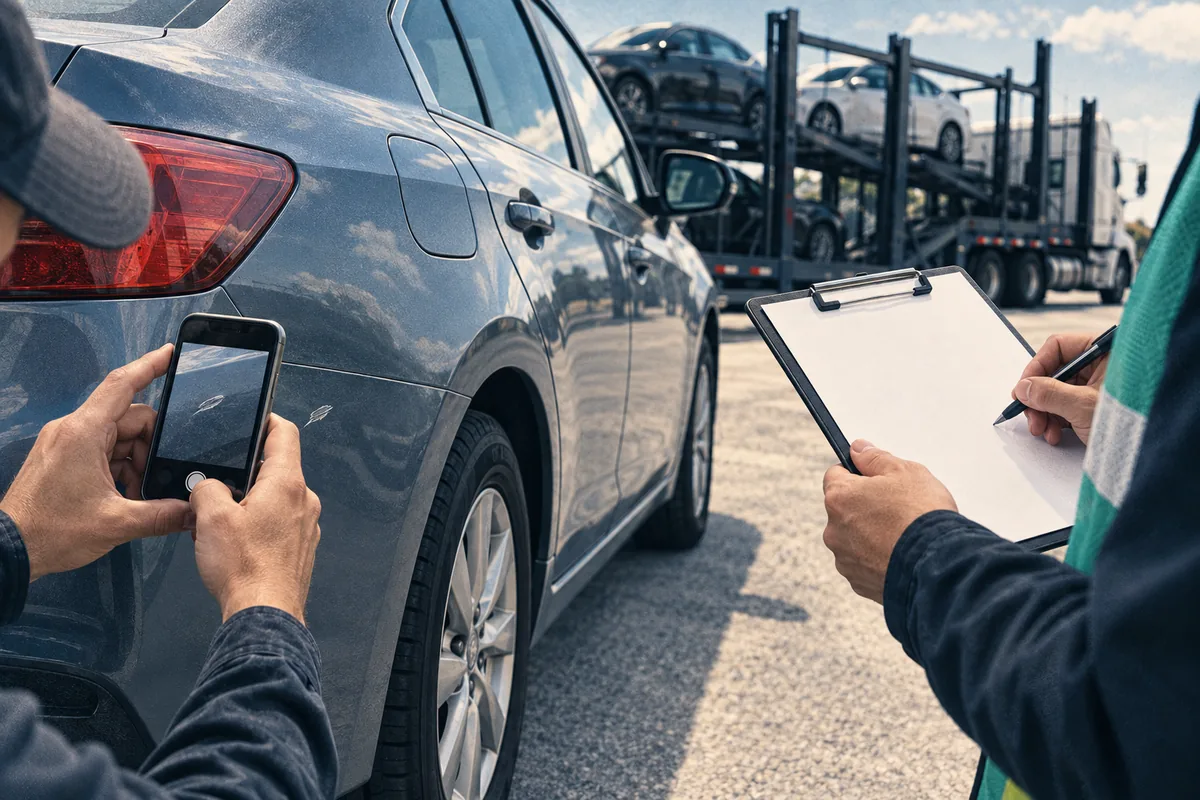
- Walk around the vehicle together, checking every panel, the roof, the wheels and the interior for existing scratches, dents, chips or mechanical issues.
- Get every mark written on the bill of lading's diagram or checklist, not just pointed out verbally.
- Confirm your vehicle's identifying details against the document: year, make, model and VIN.
- Sign the pickup copy along with the driver, and keep a legible copy for yourself.
- Only after both signatures does the vehicle get loaded onto the carrier.
What a bill of lading must legally contain
Federal regulation requires a bill of lading to name the consignor and consignee, the origin and destination points, the number of packages, a description of the freight, and weight or volume where it affects rating. Vehicle condition isn't on that list.
49 CFR 373.101 sets the minimum contents of a for-hire, non-exempt motor carrier's bill of lading, and the condition of the property being shipped isn't one of the required items. The damage diagram, the pickup-and-delivery inspection notes, and the two-signature sequence that make your bill of lading useful for a damage claim are practices the carrier's own paperwork adds on top of the federal minimum, not a requirement of the regulation itself. A carrier that skips the condition notes hasn't broken the law, so insist on them at pickup rather than assume they're built in.
What to check before you sign at pickup
Read the bill of lading next to your car, in daylight, before you sign anything. Check that every existing mark is on the diagram, that the vehicle description matches, and that you keep a legible copy.
Confirm every scratch, dent, chip and mechanical issue visible in daylight is actually written on the diagram, not just acknowledged verbally by the driver. Check that your vehicle's year, make, model and VIN on the document match your actual car. Read any language limiting what the carrier will pay for a loss. 49 U.S.C. 14706(c)(1)(A) lets a carrier limit its liability to a value you declare in writing, so a declared-value line is worth reading rather than skipping. Make sure the copy you're handed is legible, not a faded or partial carbon. Photograph both your vehicle and the signed document before the truck leaves. A photo of the marked diagram is a second, independent record of what was noted that day.
What happens at delivery
Delivery repeats the same walkaround against your pickup marks, and anything new has to be written on the bill of lading before you sign the delivery copy.
The driver and you compare your vehicle against the pickup diagram, mark anything new, and sign. The delivery signature is the point where your vehicle's condition on arrival gets recorded, and your damage claim is built on the gap, if any, between the pickup marks and the delivery marks.
What signing a bill of lading actually commits you to
Signing a bill of lading is a binding act, not a formality — the U.S. Supreme Court has described a shipper's case for damage as resting on proof of good condition at pickup, damaged condition at delivery, and the dollar amount of the loss, and your pickup signature is what supplies the first of those three.
In Missouri Pacific Railroad Co. v. Elmore & Stahl, 377 U.S. 134 (1964), the Court described that three-part showing as a prima facie case for cargo damage under federal carrier liability law. Sign a pickup copy without every existing mark noted, and you've understated your vehicle's true starting condition, which can work against you later if a dispute arises about what damage was already there. Sign a delivery copy with nothing noted, when new damage exists, and you've foreclosed the second part of that same showing: there's no longer a signed record that your vehicle arrived damaged. Neither signature can be undone once the driver has left, so read the sheet rather than rushing through it.
Bill of lading vs condition report
A bill of lading and a condition report are the same sheet of paper on most car shipments, because the carrier's damage diagram is printed directly on the bill of lading rather than as a separate form.
Carriers differ only in what they call the two functions, not in how many documents exist. Some hand you one signed sheet covering both the receipt and the inspection, while others describe the delivery signature as sign-off on a 'condition report' even when it lives on the same page as the bill of lading. Ask your carrier before pickup which it is, so you know what to keep afterward.
Who signs a bill of lading
A bill of lading is signed by the carrier's driver and the person releasing your vehicle at pickup, then by the driver and the person receiving it at delivery. If you're shipping your own car, you're both the consignor and the consignee.
The consignor is the party sending the vehicle and the consignee is the party receiving it. If someone else is picking up or receiving on your behalf, that person needs to be someone you actually authorize, since their signature is what the carrier relies on at each end.
How long should you keep your bill of lading?
Keep your signed bill of lading at least as long as any possible damage claim could still be filed, since federal law sets that window at a minimum of 9 months to file a claim and 2 years to bring a civil action.
49 U.S.C. 14706(e) bars a carrier from offering less than those two minimums, though a specific carrier's own printed terms may allow longer. Keep both your signed pickup and delivery copies, plus the photos you took at each, for at least that long — so the paperwork is still there if a problem with your vehicle only becomes obvious weeks or months after delivery.
Why moving-company paperwork rules don't apply to a car hauler
The household-goods paperwork rules for movers don't govern a car shipped on its own, because a vehicle moving alone on a car hauler isn't household goods under federal law.
49 CFR 375.101 applies Part 375's rules, including a written inventory and a delivery-day condition check, only to a household goods motor carrier moving household goods for an individual shipper in interstate commerce. 49 U.S.C. 13102(10) defines household goods as personal effects and property used or to be used in a dwelling. Your car being shipped on a car hauler doesn't fit that definition, so the inventory and condition-check rules built for movers simply don't apply to it. That's one more reason the vehicle-condition process on a bill of lading is carrier practice rather than a federal mandate: no equivalent federal rule exists for vehicles the way it does for household goods.
Frequently asked questions about the bill of lading in auto transport
- What is a bill of lading in car shipping?
It's the receipt a motor carrier issues for a vehicle it accepts for transport, required by 49 U.S.C. 14706(a)(1). On most car shipments it also works as your condition report, with a damage diagram printed on the same sheet.
- Is a bill of lading legally binding?
Yes. A carrier must issue one under 49 U.S.C. 14706(a)(1), and your signature on it records agreement to what the sheet says, condition marks included. Read it carefully before you sign.
- What should I check before I sign a bill of lading?
Confirm every existing mark visible in daylight is on the diagram, that the vehicle description matches, and that you understand any liability-limiting language. Photograph both your vehicle and the signed document before the truck leaves.
- Is a bill of lading the same as a condition report?
On most car shipments, yes. The damage diagram is printed directly on the bill of lading rather than as a separate form. Some carriers frame the delivery signature as its own 'condition report' step even though it's the same physical sheet.
- What if the driver won't write down damage on the bill of lading?
Resolve it before the truck leaves. Photograph the damage and the unmarked sheet, and note the disagreement in writing if the driver still won't record it. A later claim is argued from what the paperwork says.
- Who signs a bill of lading for auto transport?
The carrier's driver and the person releasing the vehicle sign at pickup, then the driver and the person receiving it sign at delivery. If you're shipping your own car, you're both the consignor and the consignee.
- How long should I keep my signed bill of lading?
At least 9 months, and ideally through the full 2-year civil-action window federal law sets as a minimum under 49 U.S.C. 14706(e), since that's how long a claim could still be filed or a lawsuit brought.
Last checked