Why a condition report matters when you ship a car
A damage claim gets compared against your condition report, so a scratch marked at pickup cannot later be billed to the carrier at delivery. Carriers use the report to fix a starting point nobody can dispute later, covering dents, scratches, and any mechanical trouble noted before the truck leaves.
When a condition report happens in a car shipment
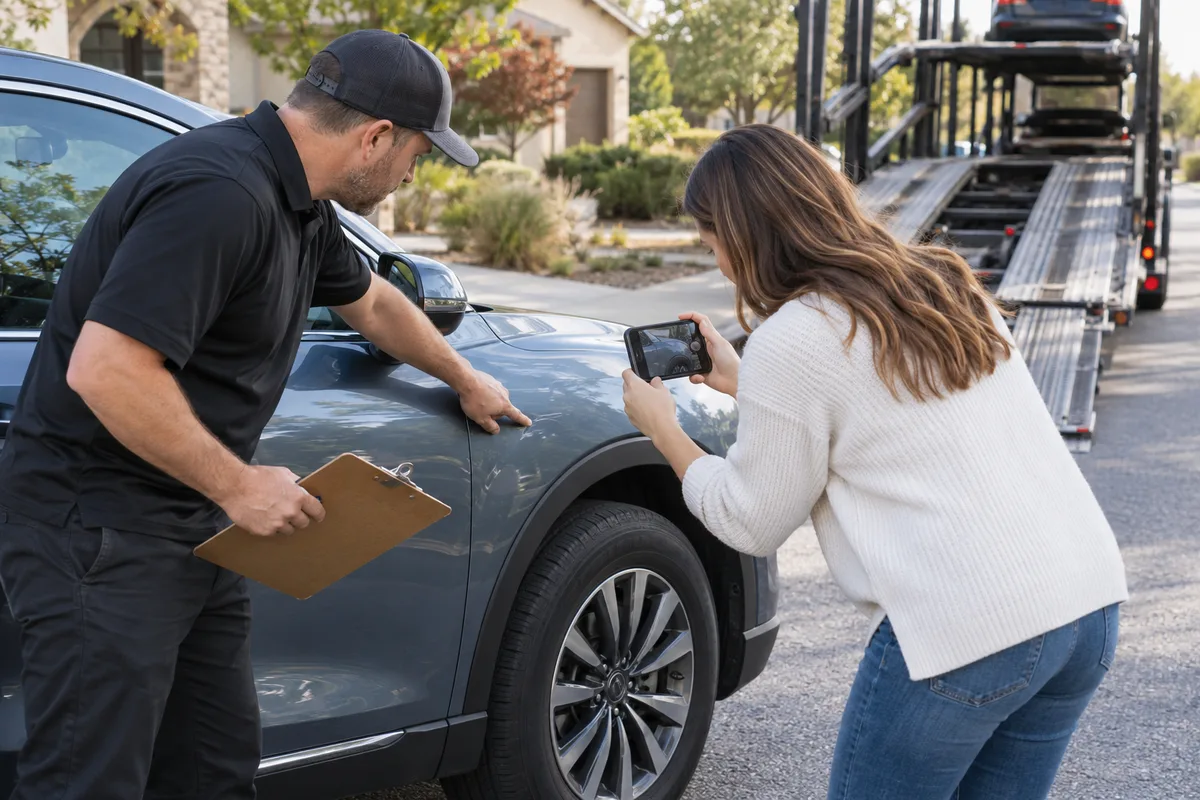
Your condition report happens twice: once when the driver takes custody of the car, and again when the driver hands it back. Pickup marks record the vehicle's condition before the carrier is responsible for it; delivery marks record what changed while the carrier had it. Any gap between those two sets of marks is exactly what a claim has to explain.
Who signs a condition report
You sign a condition report, and so does the carrier's driver. These are the same two signatures a bill of lading collects, because the two forms are usually one sheet. 49 CFR 373.101 sets what a bill of lading must contain and never mentions a vehicle's condition, so the damage-notation line on that sheet is something the carrier's own paperwork adds, not a federal requirement.
Condition report vs bill of lading
A condition report and a bill of lading are the same document on most car shipments. The damage diagram and pickup notes sit directly on the bill of lading a driver already carries. What differs by carrier is what they call the pieces: some hand you one signed sheet covering both jobs, while others frame your delivery signature as sign-off on a separate condition report even when it lives on the same page.
| Document | What it does | Where it comes from |
|---|
| Bill of lading | Names the parties, the origin and destination points, and stands as the receipt for the shipment | Required of the carrier by 49 U.S.C. 14706(a)(1), contents set by 49 CFR 373.101 |
| Condition report | Records damage at pickup and delivery, usually printed on the same sheet as the bill of lading | Carrier practice; not named or required by federal motor carrier regulation |
See bill of lading for who has to sign that shared sheet and what a clean delivery signature commits you to.
Where the definition of condition report varies
Sources disagree on whether "condition report" names a document distinct from the bill of lading, or just describes a function the bill of lading already performs.
| Definition in use | What it means in practice |
|---|
| A checklist completed during a thorough inspection before and after a car transport | The bill of lading and the condition report are the same document, described by its inspection function |
| Something a shipper signs off on at delivery, named separately from the bill of lading signed at pickup | The condition report is treated as its own step, not a synonym for the bill of lading |
| The bill of lading, documenting condition at pickup and at delivery, with no separate condition report named | The two jobs are treated as one document, and the phrase "condition report" is not used |
Federal motor carrier regulation doesn't settle which framing is correct, and doesn't require a condition report at all. 49 CFR 373.101 lists a bill of lading's required contents and never mentions a vehicle's condition. A condition-documenting requirement does exist elsewhere in federal law, but not for cars: 49 CFR 375.503 requires a household goods motor carrier to write up an inventory before loading and let the shipper check the same items and their condition at delivery. 49 CFR 375.101 limits that rule to household goods motor carriers, and 49 U.S.C. 13102(10) defines household goods as personal effects and property used in a dwelling. Your car, shipped on its own, doesn't fit that category.
Ask a carrier directly, before pickup, whether the condition report is its own paper or the same sheet as the bill of lading. On most shipments the two are the same document, so the label only matters for knowing what to keep afterward.