
Electric vehicle shipping: what changes when the car is electric
What is different about shipping an electric vehicle?
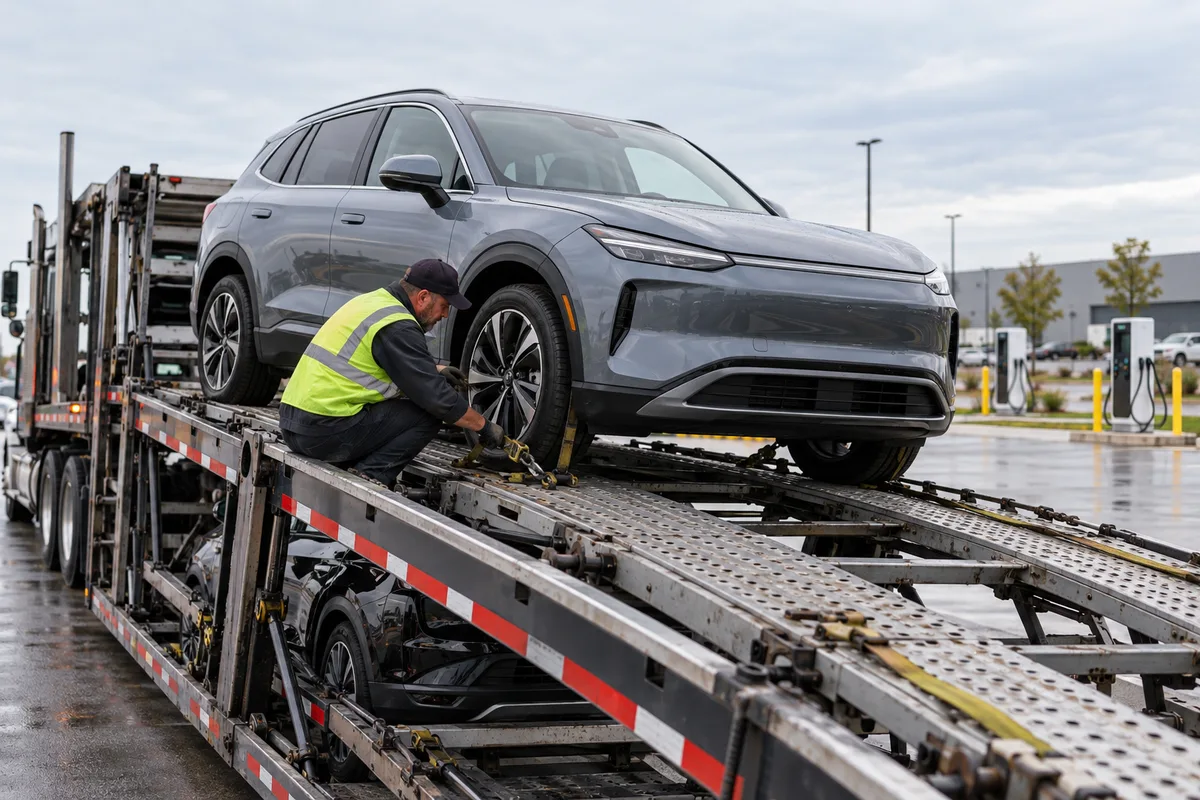
Wave Auto Transport arranges shipping for electric vehicles. Each manufacturer publishes its own instructions for moving its vehicle, and they differ by maker and by model.
Tesla's manual calls its setting Tow Mode. The name Transport Mode does not appear as a feature name on Tesla's transporter pages for the Model 3, Model Y, Model S, Model X and Cybertruck; the setting on those pages is Tow Mode. The Model 3 page says: "Tow Mode is only intended to allow for winching Model 3 onto a flatbed truck or repositioning the vehicle out of a parking space." While Tow Mode is on, "the tires are allowed to rotate slowly (under 5 mph or 8 km/h) and for a very short distance (less than 30 feet or 10 meters)." The Model Y, Model S and Model X pages give the same limits for their own vehicles, and the Cybertruck page gives "under 3 mph or 5 km/h" with the same 30 feet. Rivian's setting does a different job. Its R1T + R1S Tow Operator Guide (March 2026 edition) says: "Use Vehicle Shipping mode to preserve battery charge while the vehicle is in transit." Neither Ford's nor Chevrolet's document names a shipping setting; each states how it recommends the vehicle be moved. For any other electric vehicle, the owner's manual for that exact model is the document to follow, and Tesla's or Rivian's steps do not carry over. Wave Auto Transport moves any sort of vehicle, electric ones included: you request a quote with the make and model, we match the load to a carrier, and the carrier picks the car up.
What changes the price of shipping an electric vehicle?
There is no electric-vehicle reference price here. The live quote, which asks for your make and model, is the only price that applies to your car.
Any quote is set by vehicle details, specific pickup location, delivery location, timing of pickup and delivery, additional services, driver availability, and other market conditions. Enter the make and model in the quote form and the live quote reflects them. For a distance-based reference range on any shipment, see how much it costs to ship a car. For one lane's reference range, see California to Texas, New York to Florida or California to Florida, and California car shipping covers shipments that start in California.
How do I prepare an electric vehicle for pickup?
To prepare an electric vehicle for pickup, follow your maker's own transport instructions. Steps 2 and 3 below apply only to Tesla and Rivian, the makers whose instructions are set out here.
- 01
- 02
- 03
- 04
- 05
What does each manufacturer's own document say about moving its vehicle?
Tesla names its setting Tow Mode, Rivian names Vehicle Shipping mode, Ford names Emergency Tow, and the Chevrolet pages name none. The table below covers those four makers' own documents.
Each cell comes from that maker's own document, with the page or section where the document gives one. "Not stated" means the document does not say, and no cell borrows from another maker's manual. Tesla's and Rivian's documents are written for transporters and tow operators, while Ford's and Chevrolet's sit in the towing sections of their owner's manuals. The Ford manual is the 2025 edition and the Chevrolet manual is the 2024 edition, so a later edition of either may say something different. These are the manufacturers' statements. They say nothing about what equipment Wave Auto Transport or any carrier uses.
| Vehicle and document | Name the document uses | How the document says it is switched on | What the document says about carrying the vehicle |
|---|---|---|---|
| Tesla Model 3 and Model Y (each model's Owner's Manual, Instructions for Transporters) | Tow Mode | In Park with the tires chocked and the brake pedal held: touchscreen Controls, Service, Towing, then Enter Tow Mode. Not available while the car is plugged in; needs a detected key and low voltage power. | Each page says: "A flatbed truck or comparable transport vehicle is the recommended method of transporting" followed by its own model name. Each page says to always transport that model "with all four tires off the ground". Without a flatbed, both pages allow wheel lifts and dollies for "a maximum of 35 miles (55 km)". In Tow Mode the tires may turn only "under 5 mph or 8 km/h" and "less than 30 feet or 10 meters". Apart from the model name, the sentences quoted in this row read the same on both pages. |
| Tesla Model S and Model X (each model's Owner's Manual, Instructions for Transporters) | Tow Mode, plus Jack mode for the air suspension | Tow Mode: in Park with the tires chocked and the brake pedal held, touchscreen Controls, Service, Towing, then Enter Tow Mode; not available while plugged in; needs a detected key and low voltage power. Jack mode: Controls, then Very High with the brake pedal pressed, then Controls, Service, Jack Mode. | Each page says: "A flatbed truck or comparable transport vehicle is the recommended method of transporting" followed by its own model name. Each page says to always transport that model "with all four tires off the ground". Without a flatbed, both pages allow wheel lifts and dollies for "a maximum of 35 miles (55 km)". Each page says that to prevent damage "you must activate Jack mode to disable self-leveling". In Tow Mode the tires may turn only "under 5 mph or 8 km/h" and "less than 30 feet or 10 meters". Apart from the model name, the sentences quoted in this row read the same on both pages. |
| Tesla Cybertruck (Owner's Manual, Instructions for Transporters) | Tow Mode, plus Jack Mode if the truck has air suspension | In Park, not connected to a charge cable, tires chocked: press and hold the brake pedal, then touchscreen Controls, Service, Towing, then Enter Tow Mode. Needs a detected key and low voltage power; the page warns of a rollaway risk if low voltage power is lost while in Tow Mode. | "A flatbed truck or comparable transport vehicle is the recommended method of transporting Cybertruck." The flatbed needs "a bed that is at least 21 ft (6.5 meters) long". "Always transport Cybertruck with all four tires off the ground." Dollies are not to be used "unless absolutely necessary for a short distance". In Tow Mode the tires may turn only "under 3 mph or 5 km/h" and "less than 30 feet or 10 meters". |
| Rivian R1T and R1S (R1T + R1S Tow Operator Guide, March 2026 edition) | Vehicle Shipping mode, for battery charge in transit; Park brake release, for loading | Vehicle Shipping mode: in Park, Settings, Vehicle, Service, turn on Vehicle Shipping mode (page 12). Park brake release: brake pedal held, Settings, Vehicle, Service, turn on Park brake release; "Park brake release turns off after 15 minutes." (page 5) | "Only transport the vehicle on a flatbed tow truck." (page 5) "Pull at 5 mph (8 km/h) or less to prevent damage to the powertrain." (page 10) "Tie down the vehicle using eight-point retention straps with two points of contact per corner." (page 11) Vehicle Shipping mode is called for when transporting "over 50 mi (80 km)". (page 11) |
| Ford F-150 Lightning (2025 Owner's Manual, section Transporting the Vehicle) | Emergency Tow, a setting for flat-towing in an emergency. The section names no shipping or transport setting. | Emergency Tow: Settings, then Vehicle, then press and hold Emergency Tow until a confirmation message appears on the touchscreen; the section's steps then have the driver hold the brake pedal, shift into neutral (N) and release the parking brake. | "We recommend the use of a wheel lift and dollies or flatbed equipment to tow your vehicle." For a vehicle that becomes inoperable without access to wheel dollies or a vehicle transport trailer, the manual allows flat-towing with Emergency Tow on and the vehicle facing forward, where "Maximum speed is 35 mph (56 km/h)." and "Maximum distance is 50 mi (80 km)." |
| Chevrolet Silverado EV (2024 Owner's Manual, Transporting a Disabled Vehicle, pages 377 and 378) | Not stated. The pages read name no transport or shipping setting. | Not stated for a transport setting. For loading, the manual says the vehicle must be in N (Neutral) with the electric parking brake released, and points to Car Wash Mode (page 198) as one route to N when the vehicle has it and has 12-volt battery power. | "GM recommends a flatbed tow truck to transport a disabled vehicle." (page 378) "Do not move vehicles with drive axle tires on the ground." (page 377) If 12-volt battery power is lost, the manual says the parking brake cannot be released and the vehicle cannot be shifted to N, and that tire skates or dollies must be used under the non-rolling tires while loading and unloading (pages 377 and 378). Of the air suspension's Service mode it says: "This mode is useful when the vehicle is being towed on a flat bed or when any work under the vehicle is being performed." (page 211) |
When this page is not the one you need
If your electric vehicle will not power on or will not roll, read non-running car shipping instead of this page, because loading it needs different equipment.
Rivian and Tesla each treat a dead battery or an unavailable Tow Mode as its own case. Rivian's March 2026 guide says on page 9 to lift the rear wheels to load the vehicle when the battery is dead or the electronic park brake cannot be released, and Tesla's Model 3 page says to use self-loading dollies or tire skates when Tow Mode is not available. The choice between open and enclosed transport is the same for an electric car as for any car, and the open-versus-enclosed comparison covers it. A plug-in hybrid has a battery too, so check its owner's manual for a transport setting; the booking itself is the standard open or enclosed one.
What we do and don't do for an electric vehicle
Wave Auto Transport arranges shipping for any electric vehicle by matching it to a carrier in our network, and we do not own the trucks or handle the car ourselves.
Before a carrier is dispatched, we check that its equipment and registrations are in order. The carrier's cargo coverage is the carrier's own, not ours. Wave Auto Transport ships within the continental United States only. See the line between what a broker arranges and what a carrier does on the broker versus carrier comparison.
Electric vehicle shipping FAQs
- Can you ship a Tesla or any other electric car?
Yes. Wave Auto Transport moves any sort of vehicle, and that includes Teslas, Rivians, Fords, Chevrolets and every other electric make. Put the make and model into the quote form, which is where the order starts. Tesla's transporter page for your model, titled Instructions for Transporters, is the Tesla document to read, and it calls the setting Tow Mode.
- How do I put a Tesla into Transport Mode?
Tesla's name for the setting is Tow Mode, and on a Model 3 or Model Y you switch it on from the touchscreen: with the car in Park and the tires chocked, press and hold the brake pedal, touch Controls, Service, Towing, then Enter Tow Mode. Those pages say the car must not be plugged in, that a key must be detected, that the parking brake must be engaged and that the car needs low voltage power. Tesla describes Tow Mode as a loading aid for winching the car onto a flatbed truck or moving it out of a parking space, and the transporter pages name no separate shipping setting. The Model S and Model X pages also require Jack mode for the air suspension, and the Cybertruck page lists its own Tow Mode steps with a lower tire-speed limit. To leave Tow Mode, the Model 3 page says to touch Exit Tow Mode or shift into Park, and adds: "You must have your phone key or a key card available to restart the vehicle."
- Does Sentry Mode drain a Tesla's battery while it is parked?
Tesla's Model 3 Sentry Mode page says: "Power consumption may increase when Sentry Mode is active." The Model 3 battery page lists Sentry Mode among the sources of energy use while the vehicle is not driving and not charging. The Sentry Mode page also says "Sentry Mode is disabled by default." It gives getting towed as an example of jerky movement that makes Sentry Mode pulse the headlights and sound the alarm. That page does not say how Sentry Mode behaves on a carrier. To turn it off for more than one drive cycle, the page points to Controls, Safety, Sentry Mode. This answer is from the Model 3 manual only.
- Will my EV battery drain during shipping?
Of the manufacturer documents we read, only Rivian's ties battery charge to transit. Rivian's March 2026 guide says on page 12: "Use Vehicle Shipping mode to preserve battery charge while the vehicle is in transit." and on page 11 calls for it when transporting "over 50 mi (80 km)". Tesla's Model 3 battery page does not mention shipping; it describes a parked vehicle, saying: "The Battery can discharge at a rate of approximately 1% per day, though the discharge rate may vary depending on environmental factors (such as cold weather), vehicle configuration, and your selected settings on the touchscreen." That is a figure for a parked Model 3, not a rate for a car on a carrier. The same page says "Never allow the Battery to fully discharge." We cite no Ford or Chevrolet statement on battery charge in transit, and no document we read says how much charge a shipment uses, so we give no per-trip figure.
- What charge level should an electric car have for shipping?
None of the manufacturer documents we read gives a battery charge level for shipping, so we give none. The documents are Tesla's Instructions for Transporters pages for the Model 3, Model Y, Model S, Model X and Cybertruck, Tesla's Model 3 High Voltage Battery Information page, Rivian's R1T + R1S Tow Operator Guide (March 2026 edition), Ford's 2025 F-150 Lightning Owner's Manual and Chevrolet's 2024 Silverado EV Owner's Manual. Tesla's Model 3 battery page and Ford's 2025 F-150 Lightning manual give guidance for long-term storage of the vehicle, which is a different situation from shipping. Rivian's instruction for transport is a mode, Vehicle Shipping mode, not a charge level.
- Can a non-running electric car be shipped?
Yes. Wave Auto Transport can transport non-running vehicles using specialized equipment, and a fee for loading or unloading one may apply. Rivian and Tesla treat a dead battery or an unavailable Tow Mode as its own case: Rivian's March 2026 guide says on page 9 to lift the rear wheels when the battery is dead or the electronic park brake cannot be released, and Tesla's Model 3 page says self-loading dollies or tire skates must be used when Tow Mode is not available or the touchscreen is not accessible. Tell us at booking whether the car rolls, steers and brakes.
- Does an electric car have to ship enclosed?
No. An electric car ships on an open carrier unless you choose enclosed. The choice between open and enclosed is the same for an electric car as for any car.
- Does it cost more to ship an electric car?
Wave Auto Transport publishes no electric-vehicle price and quotes each shipment individually, so the live quote, which asks for the make and model, is the only price that applies to your electric car. What moves any quote is listed under the cost heading above, and reference ranges by distance band are on the cost page.
Last checked