
How Much Does It Cost to Ship a Car?
Expect to pay $325 to $2,075 to ship your car on open transport. Distance mostly decides where you land in that range. A short in-state move under 500 miles runs $325 to $575; a coast-to-coast move of 2,500 to 3,000 miles runs $1,175 to $1,650. This is a reference range, not your quote. Request a live quote for your specific shipment.
How much does it cost to ship a car?
Shipping your car on open transport, our default and most common option, costs $325 to $2,075 as a reference range. How far you're moving it mostly sets where in that range you land.
The ranges below are grouped by distance instead of given as one national number, because a national average hides the biggest thing that moves your price: a 300-mile move and a 2,800-mile move aren't the same job. See how we price car shipping for the full picture. None of the figures on this page are your quote. Request a live quote for your current, specific price.
How much does it cost to ship a car per mile?
Your per-mile rate falls as your distance rises: a 0-500-mile move runs $1.30 to $2.30 a mile, while a 2,500-to-3,000-mile move runs $0.43 to $0.60 a mile.
| Distance band | Miles used for the per-mile conversion | Open reference range | Implied $/mile |
|---|---|---|---|
| 0-500 miles | 250 | $325-$575 | $1.30-$2.30 |
| 500-1,000 miles | 750 | $625-$975 | $0.83-$1.30 |
| 1,000-1,500 miles | 1250 | $875-$1,200 | $0.70-$0.96 |
| 1,500-2,000 miles | 1750 | $1,000-$1,350 | $0.57-$0.77 |
| 2,000-2,500 miles | 2250 | $1,025-$1,550 | $0.46-$0.69 |
| 2,500-3,000 miles | 2750 | $1,175-$1,650 | $0.43-$0.60 |
Your per-mile rate falls as your trip gets longer because a carrier's fixed pickup and dispatch cost gets spread across more miles on a longer haul: a 0-500-mile move runs $1.30 to $2.30 a mile, while a 2,500-to-3,000-mile move runs $0.43 to $0.60 a mile.
Does the type of vehicle change the price?
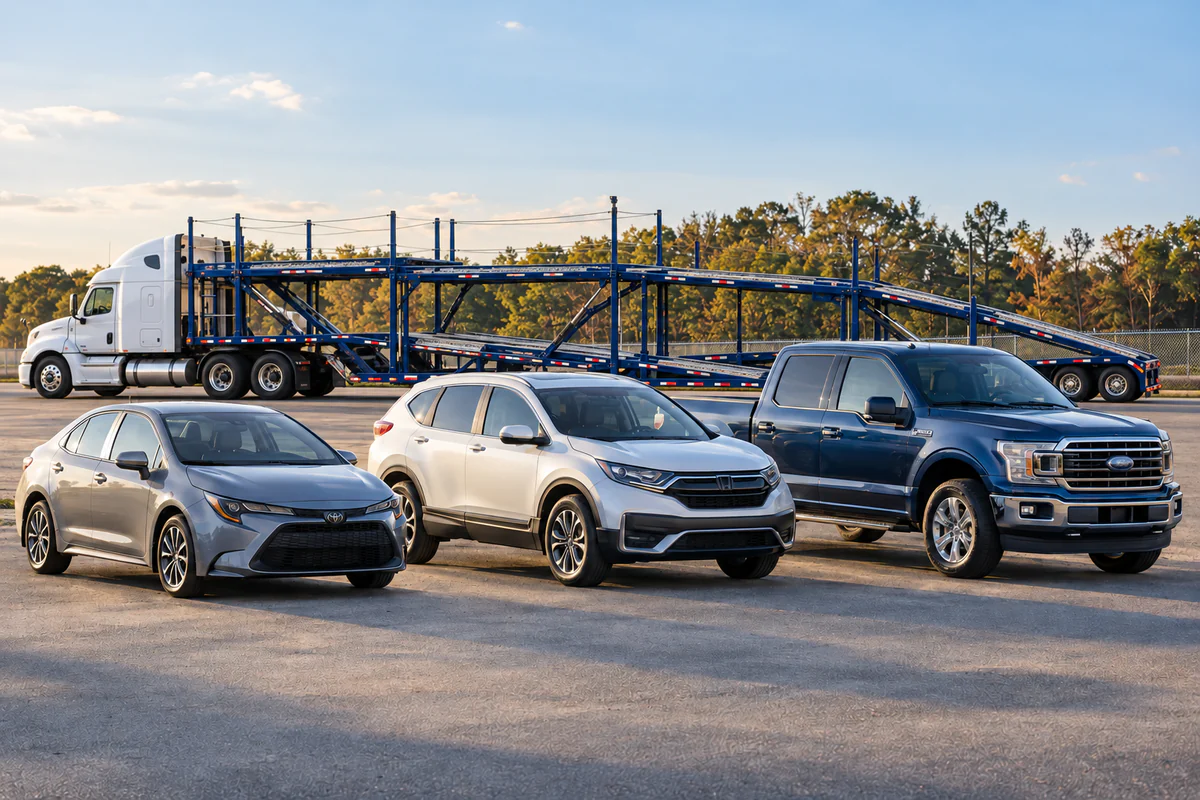
Yes, your vehicle type changes the price. A standard sedan is the baseline for every reference range on this site, and larger vehicles run roughly 7% to 35% above that baseline depending on body style.
| Vehicle type | Adjustment vs. sedan baseline |
|---|---|
| Sedan / coupe / small car | Baseline |
| Compact SUV / crossover | About 7% above baseline |
| Mid/full-size SUV | About 19% above baseline |
| Pickup truck | About 35% above baseline |
Does a non-running car cost more to ship?
A car that doesn't run may cost more to ship than the same vehicle running, because loading it requires winch equipment.
A non-running vehicle needs a winch-equipped carrier to load and unload it, which is what drives the added cost. See shipping a non-running car for the full picture.
How much more does enclosed transport cost?
Enclosed transport typically costs you 40% to 50% more than open transport on the same route.
See how much more enclosed car shipping costs for the full comparison.
Does demand change what you pay?
Yes. Demand for carrier space on your route shifts week to week, and it can push your price toward the top of the reference range or above it.
How much freight is already moving on your corridor factors into what a carrier charges, whatever your vehicle is. We can't put a number on how large that swing is. See snowbird car shipping for how seasonal demand plays out on specific corridors.
Is a reference range a quote?
No. Every reference range on this page is a planning figure for a distance, and a live quote, not a table, is what prices your specific shipment.
See how we price car shipping for the difference between the live quote and a reference range.
See real ranges for specific routes
We publish a dedicated page with its own current reference range for 20 named routes, from a 269-mile short-haul move to a 2,794-mile coast-to-coast move.
Distance and typical transit time for a few examples across that range. Each route's own page has its reference price range.
| Route | Distance | Typical transit |
|---|---|---|
| California to Nevada | 269 miles | 1-2 days |
| Georgia to Florida | 661 miles | 2-3 days |
| Texas to Florida | 1,308 miles | 3-4 days |
| New York to California | 2,794 miles | 7-9 days |
Frequently asked questions about car shipping cost
- How much does it cost to ship a car?
Open-transport car shipping costs $325 to $2,075 as a reference range, set mainly by distance. This is a reference range, not your quote for a specific shipment. Request a live quote for your current price.
- How much does it cost to ship a car per mile?
Your per-mile rate falls as distance rises: $1.30 to $2.30 a mile for a 0-500-mile move, down to $0.43 to $0.60 a mile for a 2,500-to-3,000-mile move, because a carrier's fixed pickup and dispatch cost is spread across more miles on a longer haul.
- Does the type of vehicle change the cost?
Yes. A standard sedan is the baseline; a compact SUV runs about 7% more, a mid or full-size SUV about 19% more, and a pickup truck about 35% more.
- Does a car that doesn't run cost more to ship?
Usually, yes. A non-running car needs a winch-equipped carrier to load and unload it, so the added equipment and handling may raise the price.
- How much more does enclosed shipping cost than open?
Enclosed transport typically costs 40% to 50% more than open transport on the same route. See how much more enclosed car shipping costs for the full comparison.
- Is the price on this page what I'll actually pay?
No. The figures on this page are reference ranges, not your quote for a specific shipment. A live quote, built from your actual vehicle, route and pickup date, is your real, current price.
- Why is my quote higher than the per-mile figure suggests?
Because a per-mile figure is an average for a range of distances, not a quote. The per-mile rate falls as distance rises, so a short trip sits above the average for a long one. Your live quote also varies with your vehicle details, pickup location, delivery location, timing of pickup and delivery, additional services, driver availability and other market conditions. The page on how we price car shipping covers each one.
- Why does the price vary so much by distance band?
A carrier's fixed pickup and dispatch cost is roughly the same whether your trip is 300 miles or 2,800 miles, so that fixed cost makes up a bigger share of the per-mile rate on a short trip than on a long one. That is why short hauls cost more per mile even though they cost less overall.
- Does the time of year change the price?
It can. Demand for carrier space on your route shifts week to week, which can push your price toward the top of the reference range or above it, independent of anything about your vehicle.
Last checked