
Ship a Car from California to Florida
Wave estimates California to Florida as a 2,732-mile corridor that carriers run almost entirely on I-10, with 2,225 of those miles on that single interstate. Wave estimates 6 to 8 days in transit on this lane.
California to Florida at a glance
| Road distance | 2,732 miles (Los Angeles, CA to Miami, FL) |
|---|---|
| Drive time, no stops | About 48 hours |
| Wave transit estimate, days | 6–8 |
| Reference range | $1,300–$1,750 (open transport, standard sedan) |
| Primary interstates | I-10, with short legs on I-12 and I-75 |
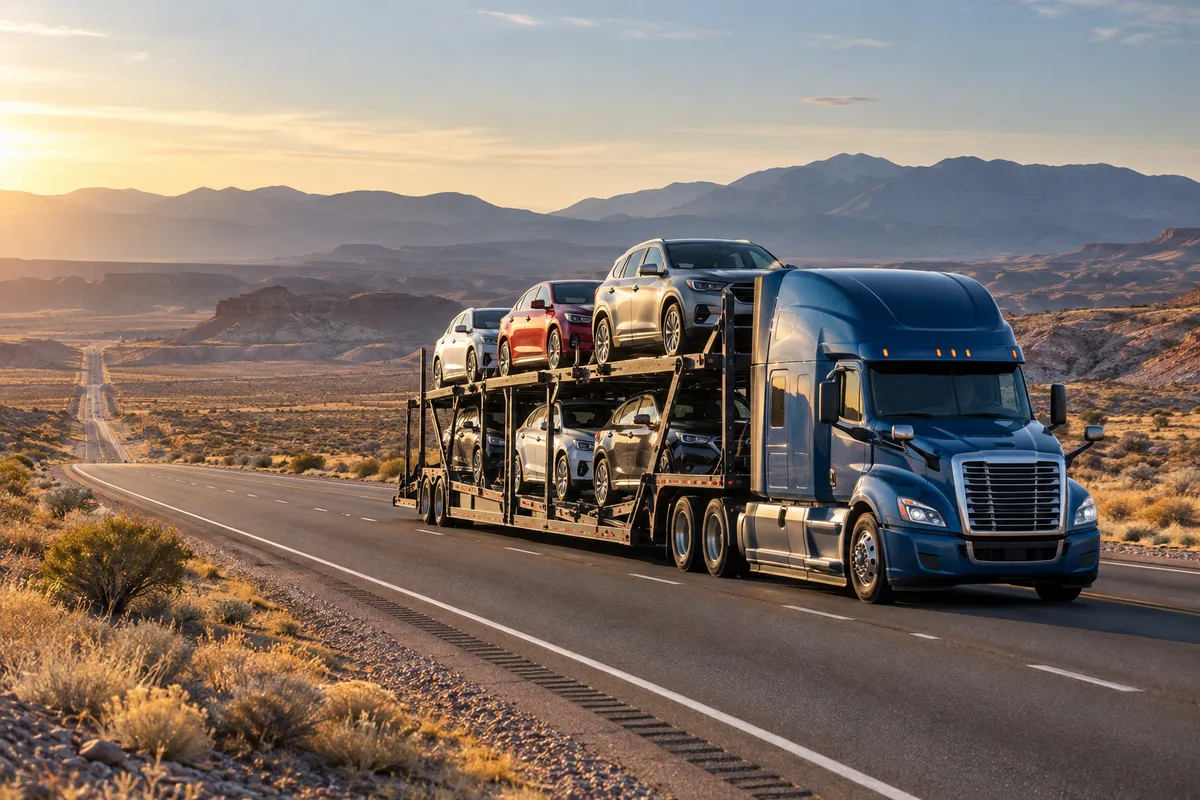
How much does it cost to ship a car from California to Florida?
Wave Auto Transport's reference range for shipping a standard sedan from California to Florida on open transport is $1,300 to $1,750 for the 2,732-mile run.
This is a reference range, not a quote, not an estimate for your shipment and not a guarantee. A real price depends on the vehicle, the pickup date, both addresses and the service level you choose, and it comes only from the quote form on this page. Wave Auto Transport arranges California-to-Florida car shipping as a licensed property broker and dispatches the move to a vetted carrier already running the I-10 corridor.
What you would pay by vehicle type
A standard sedan is the $1,300–$1,750 baseline this lane's reference range is stated for. Larger vehicles such as SUVs and pickups take more deck space and weight and cost more to haul, so the price for one depends on the exact vehicle.
| Vehicle type | Against the sedan baseline |
|---|---|
| Sedan / coupe / small car | Reference range: $1,300–$1,750 |
How long does it take?
Wave estimates 6 to 8 days in transit on this lane, counted from the day a carrier collects the vehicle to the day it is delivered.
Wave's model assumes 550 miles of driving a day, then adds whole days of dispatch and consolidation slack on top: one day on the low end for every full three driving days, and on the high end one day for a short lane or two days for every full five days on the low end. It is our own operating assumption, not a measured fleet average.
Wave estimates 9 to 13 days from booking to delivery on regular service, because the pickup window comes before any of the driving does.
| Service level | Pickup window, days | In transit, days | Total, days |
|---|---|---|---|
| Expedited | 1-2 | 6-8 | 7-10 |
| Regular | 3-5 | 6-8 | 9-13 |
| Flexible | 6-15 | 6-8 | 12-23 |
What route does the truck actually take?
Carriers moving a vehicle from California to Florida run one road for almost the whole trip: I-10 carries 2,225 of this lane's 2,732 miles, from Los Angeles through Tucson, Arizona and across the Gulf Coast states into Florida.
A Los Angeles pickup joins I-10 and stays on it through Arizona, New Mexico, Texas, Louisiana, Mississippi and Alabama: six state lines on one interstate. The only meaningful departure is 86 miles on I-12, which leaves I-10 west of Baton Rouge, Louisiana and rejoins it east of the city to skip the New Orleans approach. The last 107 miles run on I-75 after the truck is already inside Florida. Tucson, Arizona and Baton Rouge, Louisiana both sit essentially right on the interstate itself, which is worth knowing if you are timing a pickup. A single-interstate corridor is easier for a dispatcher to fill than a multi-leg one, because every carrier already on I-10 is a candidate for the load.
| Route | Used for | Interstates | Miles | Named metros |
|---|---|---|---|---|
| Primary route | not named | I-10 2,225 mi / I-75 107 mi / I-12 86 mi | 2,732 mi | Tucson, AZ, Baton Rouge, LA |
What is different about this lane?
At 2,732 miles, California to Florida is the longest of the Wave lanes that end in Florida.
Length changes the kind of job. At roughly 48 hours of nonstop driving before pickup coordination and required rest, a California-to-Florida move crosses federal hours-of-service limits several times over, so the vehicle sits parked overnight repeatedly on a schedule the driver does not control. Texas to Florida, Wave's other Gulf-side Florida lane, covers 1,308 miles and is the shorter lane. Its I-10 leg is 334 miles against 2,225 here. Wave's read is that a single-interstate corridor like this one is easier to fill than its length suggests, since a carrier anywhere along I-10 can take the load without leaving its own route. That is reasoning from the route, not a measured dispatch statistic, and Wave has no carrier-availability data to cite.
Open or enclosed on this route?
Open transport is the standard choice for most California-to-Florida shipments. Enclosed transport costs 40–50% more than open on any lane. The $1,300–$1,750 reference range above is for open transport, and there is no enclosed dollar range.
There is no enclosed dollar range for California to Florida. Use the 40–50% figure as a rule of thumb for budgeting and get a live quote for a real enclosed number. Enclosed transport earns its premium on a haul this long mainly for classic, exotic and high-value vehicles, where 2,732 miles of road spray and stone chips is the risk being paid to avoid. For a daily-driver sedan or SUV, most owners on this corridor choose open. Read open vs. enclosed car shipping for the full comparison.
How to book, step by step
Booking a California-to-Florida car shipment starts with a quote request and ends with a signed bill of lading at delivery.
- 01
- 02
- 03
- 04
- 05
Frequently asked questions about shipping California to Florida
- How much does it cost to ship a car from California to Florida?
Wave Auto Transport's reference range for shipping a standard sedan from California to Florida on open transport is $1,300 to $1,750. That is a reference range, not a quote and not a guarantee for your shipment. Get a live quote for a real, current price on your vehicle and dates.
- How long does it take to ship a car from California to Florida?
Wave estimates 6 to 8 days in transit on this lane, counted from the day a carrier collects the vehicle to the day it is delivered.
- How long from booking to delivery on California to Florida?
Wave estimates 7 to 10 days from booking to delivery on expedited service. Wave estimates 9 to 13 days from booking to delivery on regular service. Wave estimates 12 to 23 days from booking to delivery on flexible service.
- What is the driving distance from California to Florida?
The road distance between Los Angeles, CA and Miami, FL is 2,732 miles, based on OpenStreetMap road data, and 2,225 of those miles are on I-10 alone. A shipment starting in San Diego or ending in Tampa covers a different distance than the Los Angeles-to-Miami figure.
- Which highways do carriers use between California and Florida?
Carriers running California to Florida use I-10 for 2,225 of the lane's 2,732 miles, from Los Angeles through Tucson, Arizona and across the Gulf Coast states, with 86 miles on I-12 to bypass Baton Rouge, Louisiana and a final 107 miles on I-75 inside Florida. One interstate carrying more than 80% of a cross-country route is unusual and it is why this lane is simpler to dispatch than its length suggests.
- Is California to Florida a snowbird shipping route?
California to Florida runs west to east rather than north to south, so the fall-and-spring snowbird pattern documented for corridors like New York-to-Florida does not automatically apply to it. Wave has no California-to-Florida seasonal shipment data, so it cannot size any swing on this lane. See snowbird season for how that migration generally changes carrier supply and booking timing on the corridors it genuinely affects.
- Can I book enclosed transport from California to Florida?
Yes, enclosed transport is available on California to Florida, but there is no enclosed dollar range for this lane. Enclosed runs 40–50% above open. Request a live quote for a current enclosed price.
- Will a carrier deliver directly to my driveway on this lane?
Often not the whole way, and on a 2,732-mile California-to-Florida move the access problem usually turns up at both ends. Los Angeles-area pickups are frequently blocked by hillside streets and older narrow residential blocks; South Florida deliveries are more often blocked by a guard-gated community with a fixed gatehouse. In both cases the driver calls ahead and meets you at a nearby wide road, a shopping-center lot or the gatehouse instead of pulling a full-size carrier to the door.
Related routes
| Route | Why it is related |
|---|---|
| Texas to Florida car shipping | The other I-10 Gulf-side lane into Florida, at less than half the distance |
| California to Texas car shipping | Shares California as an origin and the I-10 corridor's western half |
| California to Georgia car shipping | Shares California as an origin on a comparable long-haul distance |
| New York to Florida car shipping | Shares Florida as an endpoint state |
| California to Arizona car shipping | Shares California as an origin and the first leg of this lane's I-10 run |