
What is repossessed vehicle transport and who is it for?
Repossessed vehicle transport moves a vehicle a lender has taken back. You're paying for a storage lot every day it sits there, and nobody connected to the shipment has actually seen its condition, whether the keys came with it, or whether it will even roll onto a carrier's ramps.
Repossessed vehicle transport is how we move a vehicle a lender has taken back after default. We're a broker, and we don't repossess, recover, tow or store it ourselves. The job typically runs from the recovery agent's storage lot to a wholesale or salvage auction lane, repo yard to auction. You're never the person who drove this vehicle. You're a remarketing or collateral-recovery manager at a bank, credit union or finance company moving a unit off a storage lot you're paying for; a repossession agency that recovered the vehicle and wants it dispatched; or a forwarder booking the move on a lienholder's behalf. This booking differs from almost anything else we arrange because three separate parties are involved at pickup: the recovery agent or storage lot has physical custody of the vehicle, the lienholder owns it and gets billed for the shipment, and the person who most recently drove it is usually not present at all and may never be contacted. So you have to tell us the vehicle's condition, whether the keys came with it, and whether it will even roll onto a carrier's ramps. We can't assume them.
Consumer Financial Protection Bureau data from nine lenders found repossession forwarders were used in 66 percent of completed repossessions by December 2022, up from 31 percent in early 2018. In practical terms, the forwarder often books and coordinates the move on the institution's behalf, while the lienholder remains the party with the interest in the vehicle.
Remarketing and collateral-recovery managers at banks, credit unions and finance companies; repossession agencies that have recovered a vehicle and need it dispatched; and forwarders booking a move on a lienholder's behalf.
What does it cost to move a repossessed vehicle?
A recovered vehicle is priced like any other shipment: by distance, vehicle type, and whether it can be driven on and off the truck under its own power. There is no repossession-specific price.
The reference ranges by distance band are on open car shipping, and the added cost for a vehicle that can't drive on and off the truck is covered on non-running car shipping. What your specific move actually costs, and whether it needs the standard method or the non-running one, is confirmed once we know its exact condition.
We don't have a reliable repossession-specific price range yet, so we point you to the general ranges instead of guessing at one.
How does a repo-yard pickup work, step by step?
A repo-yard pickup adds condition and access questions to our standard broker process: intake, dispatch, release, documentation and delivery.
- 01
- 02
- 03
- 04
- 05
- 06
How is a repo-yard pickup different from a driveway pickup?
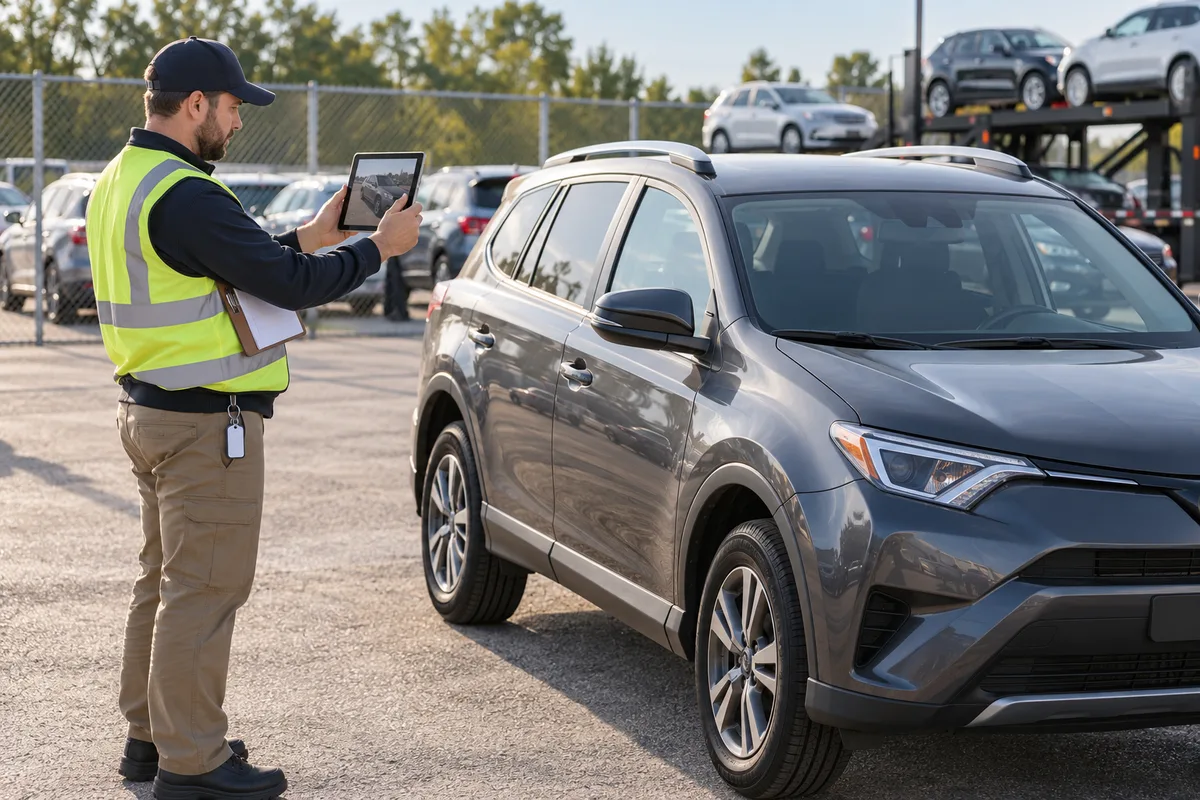
A repo-yard pickup differs from a standard driveway pickup in who releases the vehicle, who's present, and how its condition gets established. It also differs in where the vehicle goes next, who's billed, and what happens if the assigned equipment doesn't match its actual condition.
| Dimension | Repo-yard pickup | Standard driveway pickup |
|---|---|---|
| Who releases the vehicle | Whoever the recovery agent or storage lot designates, not the person who last drove it. | The vehicle's owner, who is also the person releasing it. |
| Who is present at pickup | Often nobody from the lienholder, and sometimes nobody who can speak to the vehicle's history at all. | The owner, who can describe the vehicle's condition and history directly. |
| How condition is established | The driver's bill-of-lading inspection at pickup is usually the first look anyone connected to the shipment has had at the vehicle. | The owner already knows the vehicle's condition before the driver arrives. |
| Where the vehicle goes next | Usually a wholesale or salvage auction lane. | Wherever the owner is moving to or selling the car. |
| Who is billed | The lienholder's account, which ordered the move and was never at the pickup address. | The vehicle's owner, who is also the person at the pickup address. |
| If the equipment doesn't match the condition | The load can go back into our dispatch pool for a truck with the right equipment, since nobody could confirm the condition before booking. | Rare, since the owner can usually describe the condition accurately at booking. |
When is this NOT the right page?
This page is for a lienholder, recovery agency or forwarder moving a vehicle recovered after default. It is not for a vehicle you already know doesn't run, a vehicle you bought at auction and are moving out of it, an off-lease return, or a borrower shipping their own car.
If you already know the vehicle's condition and the only question is how a non-running unit is loaded, non-running car shipping covers the equipment and added-fee mechanics directly and this page doesn't repeat them. If you bought the vehicle at an auction and are moving it out of one, that's the opposite direction from this page. Auction car shipping covers gate passes and release paperwork for a purchase leaving the lot, while this page covers a recovered vehicle moving into an auction lane. The difference from the nearest neighbouring segment is voluntary versus involuntary: a lease return is scheduled and the lessee cooperates with a lease-end inspection, while a repossession is neither scheduled nor cooperative and comes with no condition record at all. See leasing company vehicle transport for the scheduled, cooperative version of a booking where the vehicle's owner is not its driver. And if you surrendered a vehicle voluntarily and are arranging its own shipment, that's a standard retail booking with none of this page's release-authority or intake questions.
What do we do, and what don't we do?
We arrange transport for recovered vehicles as a broker; we don't repossess, recover, tow, impound or store a vehicle at any point in the process.
Repossessed vehicle transport FAQs
- Do you repossess vehicles?
No. We arrange transport after a vehicle has already been recovered. We don't repossess, recover, tow, impound or store a vehicle at any point in the process.
- Who gets named as the consignee on a repossession bill of lading?
On this kind of move, the lienholder (the bank, credit union or finance company that holds the loan) is typically the party named as consignee on the bill of lading, because federal rules require the document to name a consignee as the party receiving the shipment (49 CFR 373.101), and the lienholder is who receives it. Consignee is the general shipping term for whoever receives a shipment. The correct term for the entity holding title until the loan is paid off is lienholder, and that's the word to use for it.
- Can you move a repossessed vehicle if the keys are missing?
Yes, but missing keys change how it loads. A vehicle that still rolls, steers and brakes can often still be winched onto a standard carrier without its keys; one that doesn't needs a liftgate, forklift or flatbed instead. We don't know how often keys are missing in this segment, so tell us whether they're present when you book.
- Who has to be at the repo yard when the truck arrives?
Whoever the recovery agent or storage lot has designated release authority to. That's not the borrower, and it's often not anyone from the lienholder either. The carrier's driver works with whoever the lot puts forward to sign the bill of lading.
- Can you deliver a recovered vehicle straight to an auction?
Yes. We regularly deliver vehicles to Manheim, Copart, IAAI and ADESA when the lienholder designates one of those auctions as the destination.
- What if the vehicle turns out to be in worse condition than the booking said?
A driver who arrives expecting a winch-loadable vehicle and finds one that fails any of those checks (rolling, steering, braking) can't load it with the equipment on hand, and the load can go back into our dispatch pool for a truck with the right equipment. This comes up more often on a recovered vehicle than a retail booking, because nobody who submitted the job necessarily inspected the car first. That is why we ask the intake questions above.
- What happens to personal property left in the vehicle?
A recovered vehicle may still contain the previous driver's belongings, since nobody emptied it before it was taken. What happens to those items is a matter between the lienholder and the recovery agent under the rules of that state, not something we arrange or advise on as the transport broker.
- How fast can a recovered vehicle be picked up?
We don't publish a pickup-time commitment for this segment. How quickly we can dispatch a carrier depends on carrier availability on that specific lane, which we confirm once the job is booked.
Last checked