Why the inoperable vehicle split matters when you ship a car
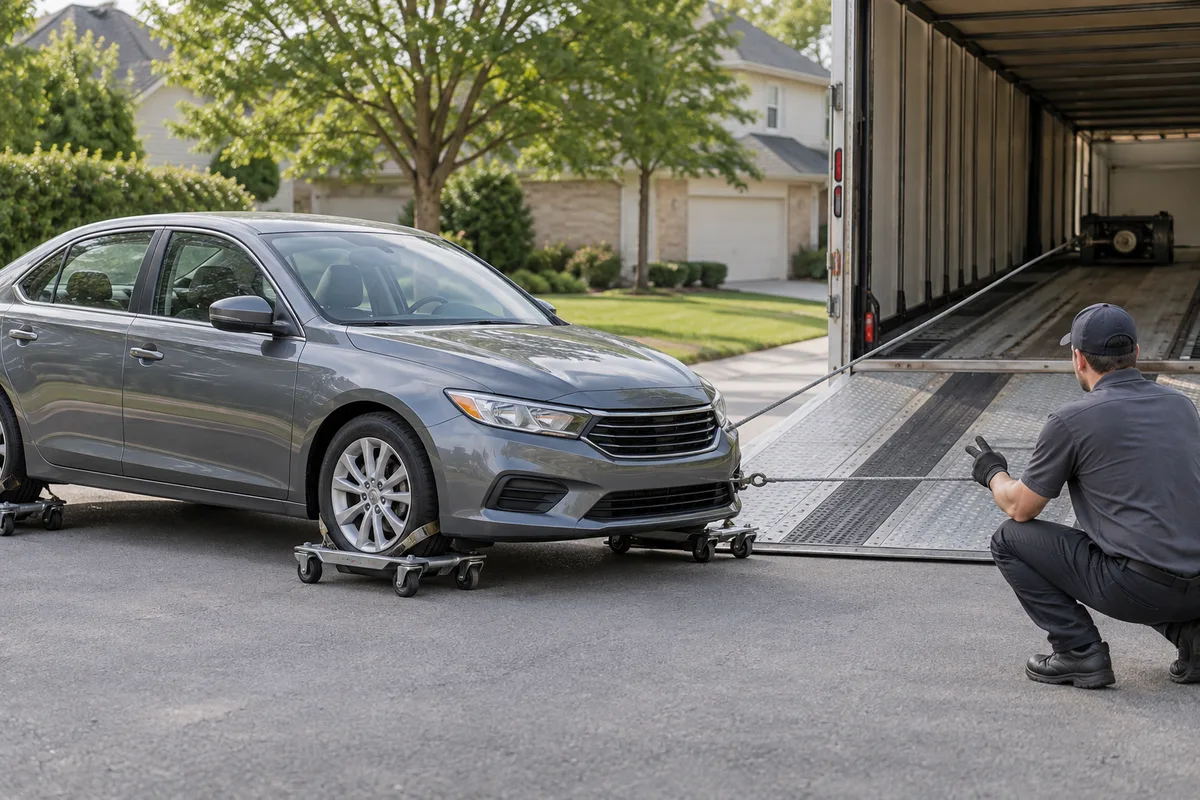
The inoperable vehicle split matters because it decides whether the truck that shows up can load your car at all, not only what the load costs. A driver dispatched with a winch can't get a car with seized wheels or a locked steering column onto the deck, and a pickup that fails on that mismatch sends the vehicle back into the dispatch pool. Winch loading and lifting are separate capabilities, and a carrier who has one doesn't always have the other.
What rolls, steers and brakes means for an inoperable vehicle
Rolls, steers and brakes is the three-part mechanical check a carrier runs before treating your inoperable vehicle as winch-loadable rather than lift-only. Each part covers a different moment in the loading sequence, and a car can pass two of them and fail the third.
| Check | What it means | What breaks it | Why it matters during loading |
|---|
| Rolls | Wheels turn freely and the transmission can be put in neutral | Seized brake, flat or missing tire, transmission locked in park, collapsed wheel bearing | A winch pulls, but the car still has to travel up the ramp on its own wheels |
| Steers | The front wheels answer the steering wheel and the column is unlocked | Locked ignition column, no key, broken tie rod, front suspension damage | Someone has to aim the car between two narrow ramps and along the deck |
| Brakes | The car can be stopped and held on a slope | Empty or cut brake lines, an electronic park brake with no power to release it | The car has to hold still on an angled deck until it is chained down |
Naming the specific failure at booking is what lets a carrier choose between a winch, a liftgate and a forklift before the truck is even dispatched.
When an inoperable vehicle has to be disclosed
You have to disclose an inoperable vehicle at the point you create the order, before a carrier bids on it, because equipment gets assigned with the load rather than added later. The disclosure that does the work names which functions the car has lost, not just that the engine won't start. At pickup, the driver records your car's condition on the bill of lading, and a car that turns out lift-only when the order said winch-loadable is exactly where a load stalls in the driveway.
What federal regulation says about an inoperable vehicle
Federal motor carrier regulation doesn't define an inoperable vehicle, which leaves the term to each company's own booking terms. 49 CFR 393.5, the definitions section for the federal cargo securement rules, defines terms including tiedown, anchor point and working load limit, and defines neither inoperable nor non-running (law.cornell.edu). 49 CFR 393.128 scopes its automobile securement rules by weight and body type, covering automobiles, light trucks and vans that individually weigh 10,000 pounds or less, and says nothing about whether the vehicle can be driven (law.cornell.edu). 49 CFR 393.132 is the one automobile securement section written around a physical condition, and the condition it names is a vehicle that's been flattened or crushed (law.cornell.edu). The securement standard doesn't change because your car won't start. The gap between an inoperable vehicle and a running one shows up in the loading, not the tiedowns.
Where the definition of an inoperable vehicle varies
Car shipping companies agree on what an inoperable vehicle is. They differ on whether one that can't roll, steer and brake is still something they'll move, or a load outside the service altogether.
| Published treatment | What it means in practice |
|---|
| A non-running vehicle can still be shipped as long as it can roll, steer and brake | Rolling, steering and braking are a condition on the service itself |
| The vehicle must be able to brake, steer and roll onto a trailer | A common industry norm rather than a fixed rule, where a forklift is an alternative to a winch |
| The surcharge varies with whether the vehicle rolls, steers and brakes | A pricing variable inside the non-running category, not a gate on entry to it |
Nothing in the federal sections above settles the difference, because inoperable vehicle is a commercial service description, not a defined regulatory category. If your car won't start, state in writing which of rolling, steering and braking it still does, and ask what equipment the assigned carrier will bring. A checkbox marked non-running carries none of that detail.