Why a non-running vehicle surcharge matters when you ship a car
A non-running vehicle surcharge matters because it changes which carriers can accept your load, not only what it costs. Winches and liftgates aren't standard equipment on every trailer, so a shipment listed as non-running is visible to a smaller pool of carriers than one that drives on and off under its own power. A smaller carrier pool can mean a longer wait before a truck accepts the load, on top of whatever the surcharge adds to the price.
When a non-running vehicle surcharge applies to a shipment
A non-running vehicle surcharge applies at booking, once you disclose the vehicle's condition as non-running, and again at pickup if the carrier's own inspection finds a condition you didn't report. Book a vehicle as running when it actually needs to be pulled or lifted onto the trailer, and you risk a driver who shows up without the right equipment and can't load the car that day. The condition you disclose at booking is what a carrier plans equipment and time around, so an accurate description at quoting keeps your pickup date on schedule.
How loading equipment changes with a non-running vehicle
A non-running vehicle changes how a carrier gets it onto the trailer, not how it has to be secured once loaded. 49 CFR 393.128 requires automobiles, light trucks, and vans carried as cargo to be "restrained at both the front and rear to prevent lateral, forward, rearward, and vertical movement using a minimum of two tiedowns," with no separate standard for a vehicle that cannot be driven. The non-running vehicle surcharge pays for the work of reaching those tiedown points, not for a looser safety standard once your vehicle is loaded.
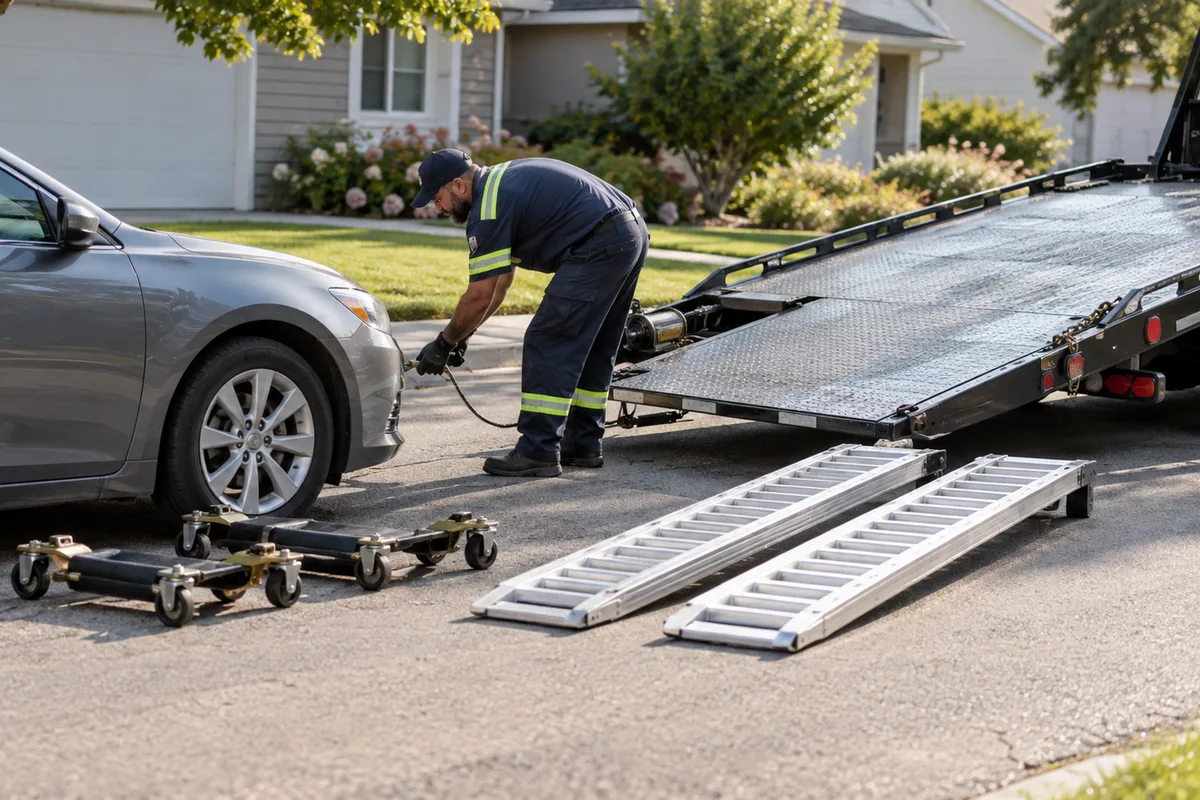
A vehicle that still rolls and steers can often be pulled into position with a tow strap or a hand-operated winch, because the wheels still turn. A vehicle that won't roll or steer at all needs a powered winch, a liftgate, or a forklift to move it onto the deck, and both routes take longer than a car driving aboard on its own.
Non-running vehicle surcharge vs low ground clearance fee
A non-running vehicle surcharge and a low ground clearance fee get charged for two different physical problems, even though both can call for a liftgate.
| Non-running vehicle | Low ground clearance vehicle |
|---|
| What is wrong | Engine, transmission, wheels, steering, or brakes will not let it move under its own power | Vehicle drives normally, but its underside can strike a standard ramp angle |
|---|
| Equipment it can require | Tow strap or hand winch if it still rolls and steers; a powered winch, liftgate, or forklift if it does not | Liftgate or low-angle ramps |
|---|
| Depends on how the vehicle drives | Yes, this is the entire trigger | No, the vehicle can drive perfectly and still need this equipment |
|---|
Your vehicle can be non-running and low to the ground at the same time, such as a modified car that also won't start, and a carrier pricing the load has to plan equipment for both conditions rather than assume one explains the other.
Where non-running vehicle surcharge amounts vary
The non-running vehicle surcharge varies from company to company, and it can vary from route to route. No public rate table sets the amount, so a carrier or broker prices each shipment on its own. Ask for the surcharge to be itemised in your quote, and get that figure in writing.