GlossaryTransport types

What Is Terminal-to-Terminal Car Shipping in Auto Transport?

Meeting the truck yourself can save money, or it can mean driving somewhere for nothing. Terminal-to-terminal shipping means you pick up or drop off your car at a carrier's fixed terminal instead of having the driver come to your address.

Some companies sell this as a lower-cost tier you can pick at booking. Others only use a terminal as a fallback, once a carrier finds out it can't reach your address directly. A terminal, either way, is a staging yard the carrier network already runs, not a spot built around your order alone.

Also called
terminal-to-terminal car shipping, terminal shipping, drop-off shipping, terminal drop-off and pickup
Sources
8
Last updated
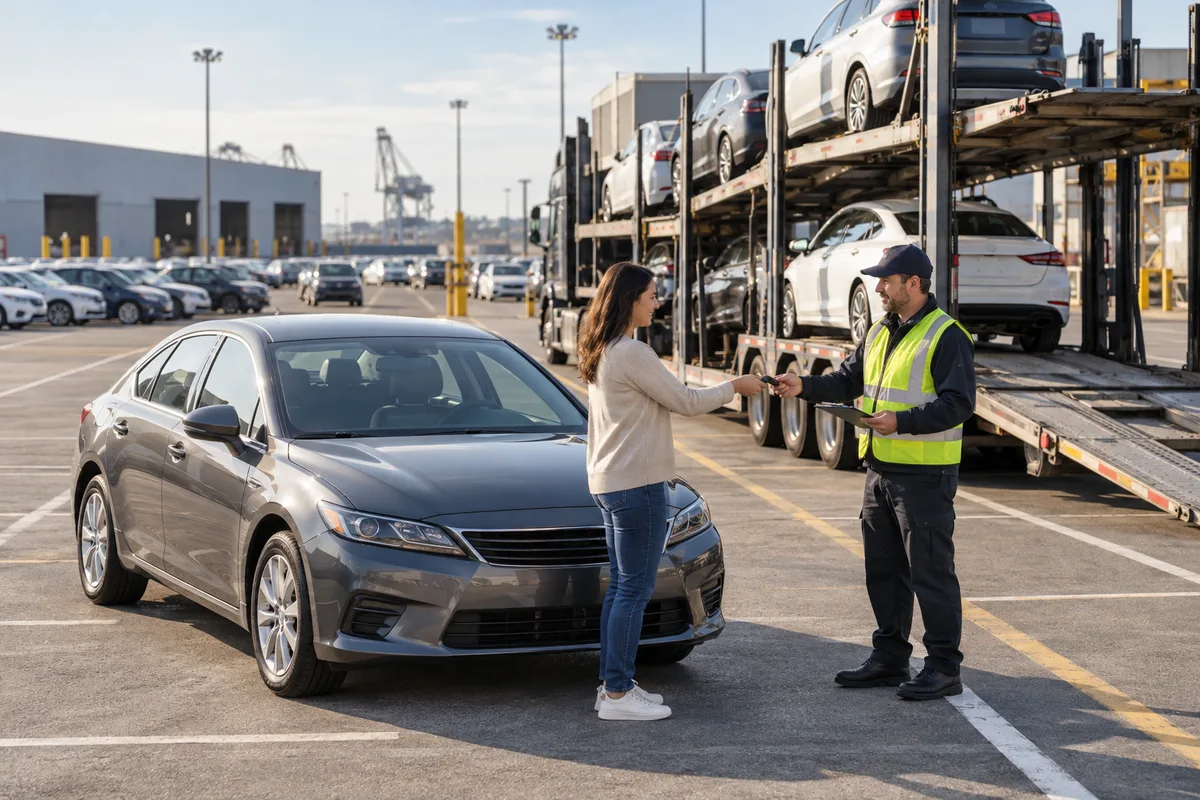
A customer handing off a sedan at a secure vehicle transport terminal. Illustration of a vehicle handoff at a terminal used for transport staging.

Why terminal-to-terminal shipping matters when you ship a car

Terminal-to-terminal shipping hands part of the work of your shipment back to you instead of leaving all of it with the driver. Terminal routing happens when a pickup or delivery location is inaccessible, when the schedule calls for temporary storage before final delivery, or when the carrier cannot reach the customer to arrange an alternative. A car routed through a terminal sits on that terminal's own hours and its shipment's pickup window for the next leg, instead of moving straight from pickup to delivery, which can add days a direct run wouldn't.

When terminal-to-terminal shipping happens in a car shipment

Terminal-to-terminal shipping gets sold two different ways under the same name: as a selectable option for a customer with scheduling flexibility who puts cost ahead of convenience, and as a fallback when a carrier cannot reach an address. The sticker price can be lower than door-to-door either way, but the customer then plans for the trip to the terminal and, depending on pickup timing, for storage costs. In practice, it's usually your assigned carrier, not a fixed rule, that decides whether a specific shipment routes through a terminal at all.

Terminal-to-terminal shipping vs door-to-door shipping

Terminal-to-terminal and door-to-door differ in where you meet the truck and who covers the last stretch of the trip, not in the trailer hauling your car.

Terminal-to-terminal shippingDoor-to-door shipping
Where the vehicle changes handsA fixed terminal or storage lot in the carrier's networkAn address the customer names, or the nearest point the truck can safely reach
Who travels to close the final gapThe vehicle owner, to and from the terminalThe driver, toward the named address
How it is offeredA selectable lower-cost tier, or a fallback after an address cannot be reachedThe default service most companies sell first
Storage-fee exposureA possible charge if pickup runs lateNot a storage issue, since the vehicle is not left at a terminal

A quote built on a terminal-to-terminal price still depends on which version produced it: a genuine discount for being willing to travel, or the only routing a carrier can offer for your specific address.

Where the definition of terminal-to-terminal shipping varies

Sources agree on what a terminal is and differ on whether reaching one is a discount you choose at booking, or a routing exception the carrier imposes after your address doesn't work.

Definition in useWhat it means in practice
A routing exception, triggered by an inaccessible location, a scheduling need for temporary storage, or an unreachable customerTreated as something that happens to a shipment, not something booked from the start
A lower-sticker-price alternative to door-to-door, paired with a warning about added trips and possible storage costsTreated as a deliberate cost trade-off
A budget-friendly, selectable service tier for a customer with scheduling flexibility, set against door-to-door on cost and convenienceTreated as a first-class option, with storage fees disclosed as a risk for a late pickup
Terminal drop-offs and pickups, used when door-to-door is not possible because a carrier cannot reach narrow residential streetsTreated as the fallback path, offered alongside door-to-door rather than sold against it

No federal regulation sets a definition for terminal-to-terminal shipping either. None of the four sections checked for door-to-door mentions the phrase: 371.2 (broker definitions), 373.101 (bill of lading contents), 375.103 (a household-goods-only part) and 390.5 (general safety definitions). Terminal-to-terminal, like door-to-door, is a service label each company writes for itself, not a term a regulator has set.

Before you book on a terminal-to-terminal quote, ask directly whether the lower price reflects a real discount for using the terminal, or whether the company already routes every shipment for your address through a terminal because it can't reach you, and get any storage-fee terms for a late pickup in writing. A carrier that can't reach your address might offer a nearby meet-out point rather than a terminal; the two aren't interchangeable, because a meet-out point keeps your shipment inside door-to-door shipping, while a terminal is a separate location on its own schedule that you have to travel to.

Frequently asked questions about terminal-to-terminal shipping

What is terminal-to-terminal car shipping?
It's a service where your car is picked up and delivered at a fixed carrier terminal instead of the addresses you name, offered either as a selectable lower-cost tier or as a routing fallback when your address can't be reached directly.
Is terminal-to-terminal shipping cheaper than door-to-door shipping?
It can carry a lower sticker price on some quotes. The trip to the terminal and possible storage costs come on top of that price, so your full cost depends on both numbers, not the sticker alone.
Does terminal-to-terminal shipping only happen when an address cannot be reached?
No. Terminal-to-terminal shipping can be a selectable option for a customer with scheduling flexibility, and it can also be a fallback used when an address is inaccessible, needs temporary storage, or cannot be reached.
Are there storage fees if my car sits at a terminal too long?
Storage fees are a possible charge when a terminal pickup runs late, and that charge is separate from an auction storage fee, which accrues at a vehicle auction lot before a carrier ever arrives.
Does federal law define terminal-to-terminal shipping?
No federal rule defines it. A check of 49 CFR 371.2, 373.101, 375.103, and 390.5 found no mention of the phrase in any of the four. Terminal-to-terminal is a commercial service label, not a regulated term.

Sources and last checked

  1. Supports

    Negative finding: the phrase terminal-to-terminal does not appear in the broker definitions section.

    Cornell Law School, Legal Information Institute — 49 CFR 371.2 - Definitions

    Checked

  2. Supports

    Negative finding: the phrase terminal-to-terminal does not appear in the bill of lading contents section.

    Cornell Law School, Legal Information Institute — 49 CFR 373.101 - Bills of lading

    Checked

  3. Supports

    Negative finding: the phrase terminal-to-terminal does not appear in the household goods definitions section. This section governs household goods carriage only, not auto transport.

    Cornell Law School, Legal Information Institute — 49 CFR 375.103 - What definitions are applicable to this part?

    Checked

  4. Supports

    Negative finding: the phrase terminal-to-terminal does not appear in the general safety definitions section.

    Cornell Law School, Legal Information Institute — 49 CFR 390.5 - Definitions

    Checked

Related terms

Glossary entries

All glossary terms