Why less-than-truckload matters when you ship a car
Less-than-truckload matters on your car shipment because the phrase describes how a trailer gets filled and says nothing about speed, price or care in handling. Read as a loading pattern, the label is useful, because a trailer holding other people's cars carries other people's stops too.
Under 49 CFR 373.101, a for-hire motor carrier has to issue a receipt or bill of lading for property it takes for transportation, naming the consignor and consignee, the origin and destination, the freight and its weight where that figure is used to rate it (law.cornell.edu). One trailer carrying five customers' vehicles generates five sets of paperwork, and each owner signs for their own vehicle only.
How less-than-truckload works in general freight
Less-than-truckload freight moves through a terminal network instead of running straight from one dock to the next. The Federal Highway Administration's freight glossary defines less-than-truckload as a container or trailer loaded with cargo from more than one shipper, covering loads that don't on their own meet truckload requirements, a truckload being the quantity needed to fill a truck or to qualify for a truckload rate (ops.fhwa.dot.gov). The split is about quantity per customer, not equipment: one trailer can run either way on consecutive days.
The Federal Highway Administration also records that triple-trailer combinations are operated mainly by less-than-truckload carriers moving small packages between their own terminals (fhwa.dot.gov). Freight moving through a terminal network gets unloaded, sorted and reloaded in transit, the part of the model that doesn't carry over to a car strapped to a deck, unless your booking is terminal-to-terminal shipping and a handoff is planned.
Where the less-than-truckload label breaks down on a car carrier
The less-than-truckload label breaks down where a trailer holds one vehicle for one customer, because a single shipper's load is what every definition cited here excludes. Every authority cited here was written for general freight in trailers and containers, not for assembled vehicles riding on a car hauler.
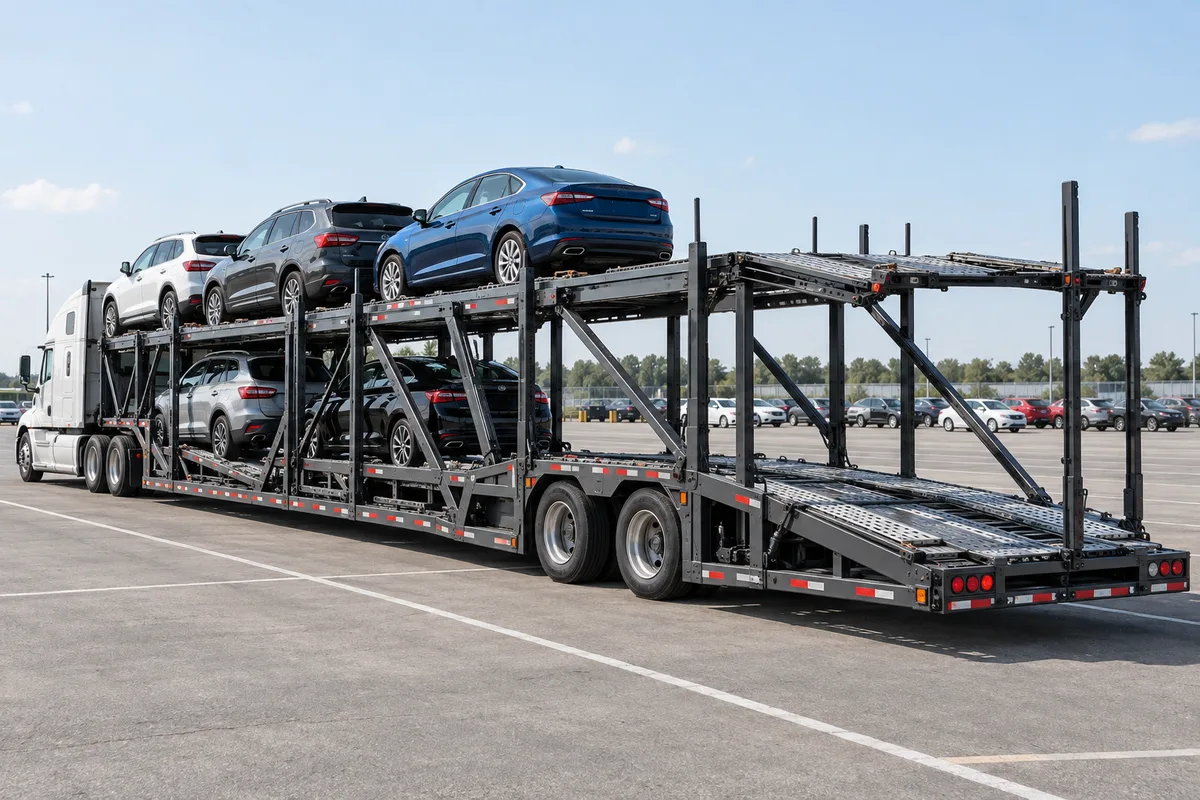
Federal law gives car hauling its own equipment category rather than a fullness category. 49 U.S.C. 31111 defines an "automobile transporter" as "any vehicle combination designed and used for the transport of assembled highway vehicles, including truck camper units," and states that such a transporter is not prohibited from carrying "cargo or general freight on a backhaul" within truck tractor and semitrailer weight limits (law.cornell.edu, wording confirmed on govinfo.gov). A rig stays an automobile transporter whether it rolls out full or nearly empty, so the number of vehicles aboard is a fact about your booking, not a regulatory class.
Less-than-truckload, truckload and a loaded car carrier compared
Less-than-truckload, truckload and car hauling split on three questions: whose cargo is aboard, what happens to it en route, and how many receipts the trip produces.
| Less-than-truckload freight | Truckload freight | Loaded open car carrier |
|---|
| Whose cargo is aboard | More than one shipper's | One shipper's | Usually several vehicle owners' |
|---|
| What fills the trailer | Several partial lots | One load that fills it | Vehicles booked one at a time |
|---|
| Handling en route | Sorted and transferred at terminals | Loaded once, delivered direct | Loaded once, unloaded at each stop |
|---|
| Receipts issued | One per shipment | One for the load | One bill of lading per vehicle |
|---|
Where the meaning of less-than-truckload varies
Freight sources and car shipping sources use the same words and differ on scope, meaning what the label is allowed to cover.
| Definition in use | What it means in practice | Where it appears | Source | Checked |
|---|
| A container or trailer loaded with cargo from more than one shipper; loads that do not by themselves meet truckload requirements | The label describes how full a trailer is and how many customers share it | Federal Highway Administration freight glossary | ops.fhwa.dot.gov | September 2026 |
| Less-than-truckload lots held in a terminal area for transfer from one vehicle to another to continue in transportation | The label describes a partial lot that changes trucks at a terminal | Pipeline and Hazardous Materials Safety Administration, Federal Register, November 16, 2005 | govinfo.gov | September 2026 |
| Hotshot car hauling described as a type of less than truckload (LTL) | The label is applied to rapid single-vehicle hauling on a small dedicated trailer | Car shipping pages | — | — |
Less-than-truckload is not a legal category in any federal transport statute we checked. The definitions section of the federal motor carrier chapter, 49 U.S.C. 13102, defines the vocabulary used throughout that chapter, including broker, carrier, motor carrier, household goods and transportation, and neither less-than-truckload nor truckload appears among the defined terms (law.cornell.edu). Read less-than-truckload on a car shipping page as a claim about the trailer and nothing else, then ask the carrier the question behind it: does your vehicle travel alone, and how many stops come first?