
GlossaryTransport types

What Is Hot Shot Car Transport in Auto Transport?

One car, one truck, no waiting for a multi-car route to fill up. Hot shot transport is a vehicle-hauling service that uses a medium-duty pickup and a small flatbed trailer, not a standard carrier's multi-car rig.

The trailer is an open flatbed in most cases, though it can be enclosed when the load needs extra protection. Hot shot transport is built for a single vehicle that needs to move on a schedule a standard multi-car carrier's route can't match.
Also called
hot shot car hauling, hotshot trucking, hot shot hauling
Sources
2
Last updated
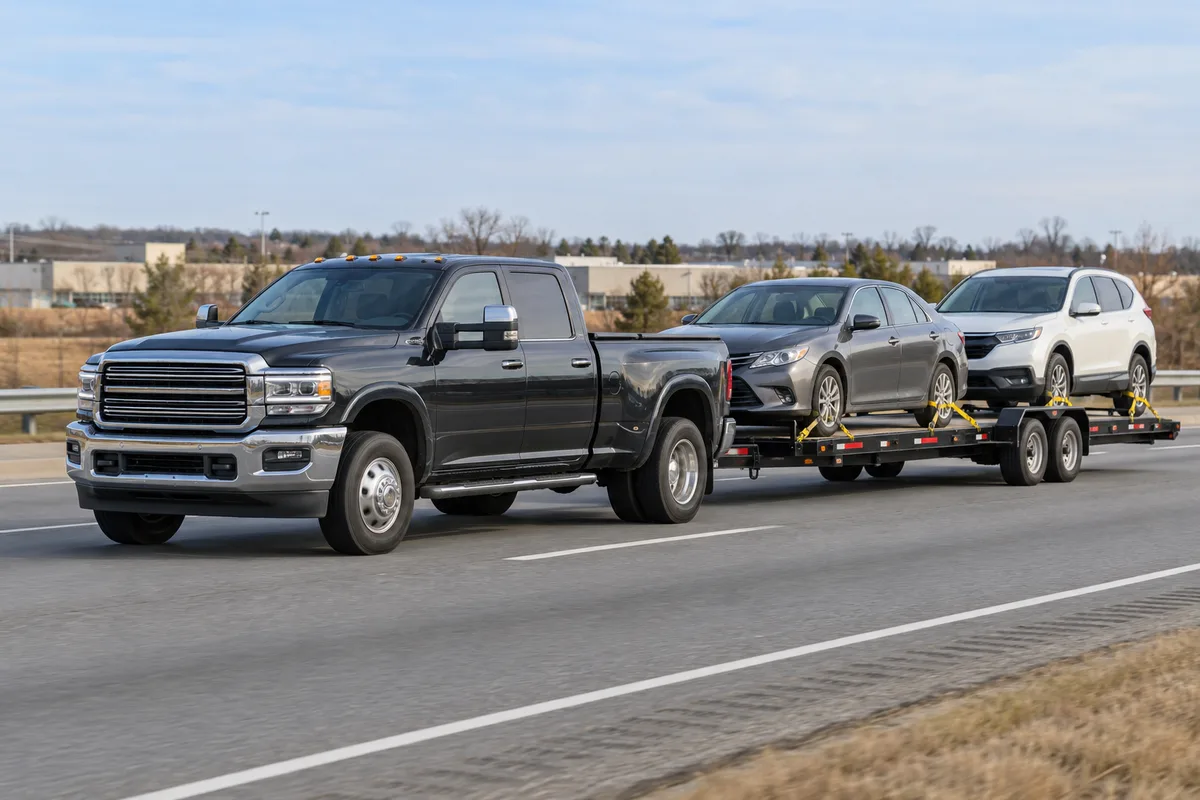
A heavy-duty pickup towing two vehicles on a compact open trailer. Illustration of the smaller equipment commonly used for hot-shot transport.

Why hot shot transport matters when you ship a car

Hot shot transport matters because it exists specifically for a single vehicle that needs to move faster than a standard multi-car carrier's route allows. A hot shot load is found and accepted through a public load board by an independent owner-operator working between other jobs, rather than dispatched to a carrier already scheduled on a company's standard route — which is why a hot shot request can get a faster response than waiting for a scheduled carrier to line up. A dually, a heavy-duty consumer truck with two rear wheels, is sometimes used for a larger hot shot load, though most hot shot transport doesn't need one.

When hot shot transport is used in a car shipment

Hot shot transport gets used when a single vehicle needs to move faster than a scheduled multi-car route can deliver it, or when a shipment has already fallen behind schedule and a smaller dedicated trailer is the fastest way to catch up. Hot shot transport runs on the same interstate network as a standard shipment, and a hot shot hauler's smaller size and better maneuverability let it reach some routes and residential streets a large open carrier can't.

Hot shot transport vs expedited shipping

Hot shot transport and expedited shipping both move a vehicle faster than a standard shipment, but they use different equipment and different drivers to do it.

Hot shot transportExpedited shipping
Truck and trailerA medium-duty pickup, sometimes a dually, pulling a small flatbed sized for one or two vehiclesThe same multi-car open or enclosed carriers used for a standard shipment
Who drives itAn independent owner-operator, usually found through a load boardA carrier already in the broker's regular network, scheduled sooner than usual
Best fitA single vehicle that needs a dedicated truck off the standard routeA shipment that needs to move up the schedule but does not need a dedicated small truck

Hot shot transport carries one shipper's vehicle on a dedicated small trailer, a different arrangement from less-than-truckload freight, where multiple shippers' partial loads share space in one trailer. A hot shot load and an LTL shipment aren't the same thing, even though both move less than a full trailer.

Frequently asked questions about hot shot transport

Is hot shot transport the same as expedited shipping?
No. Hot shot transport uses a smaller dedicated truck and trailer, usually driven by an independent owner-operator found through a load board. Expedited shipping uses the same multi-car carriers as a standard shipment, scheduled sooner.
Does hot shot transport cost more than a standard carrier?
Usually. Hot shot transport commits a dedicated smaller truck and trailer to your one load, instead of splitting the trip's cost across several vehicles the way a multi-car carrier does.
Can a hot shot truck carry more than one vehicle?
Sometimes. A hot shot trailer is sized for one vehicle most of the time, though a small or medium flatbed can occasionally take two smaller vehicles.
Is hot shot transport the same as less-than-truckload freight?
No. Hot shot transport carries one shipper's vehicle on a dedicated trailer. Less-than-truckload freight combines partial loads from multiple shippers in a single trailer, which is a different arrangement.

Related terms

Glossary entries

All glossary terms