Why door-to-door shipping matters when you ship a car
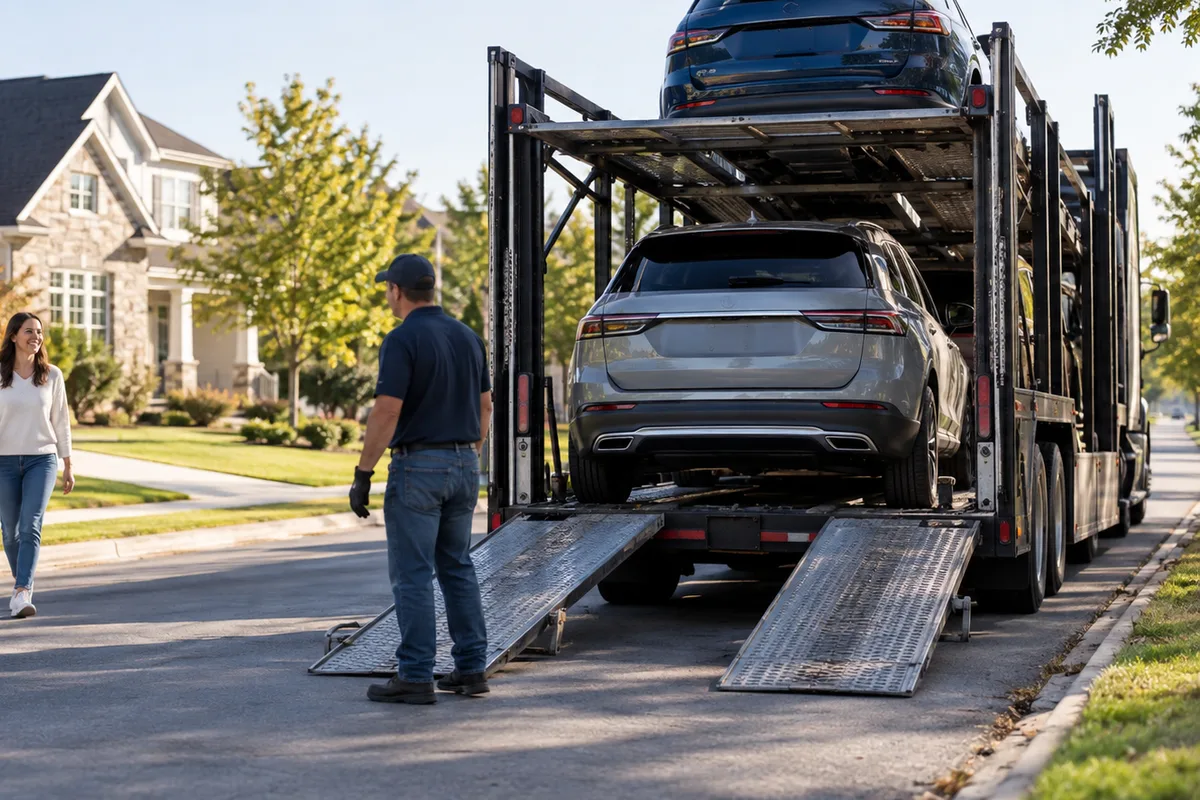
Door-to-door decides whether you drive to a shipping yard before and after the move, and how close the truck actually gets to your door depends on the street, not on the label a company sells. A driver picks up and delivers as close to your door as is legal and safe. Where narrow streets, low-hanging trees, HOA rules or a low bridge get in the way, the driver phones ahead and meets you at a nearby spot such as a parking lot, an intersection or a major road. The address on your order and the spot where the vehicle changes hands can end up several blocks apart, and you are still getting the door-to-door service you paid for.
When door-to-door shipping happens in a car shipment
Door-to-door shipping happens at both ends of your shipment: once at pickup, inside your agreed pickup window, and again at delivery, inside the delivery window. At each end, your assigned carrier calls ahead, and if your named address turns out to be one the truck can't safely reach, proposes a nearby meet-out point, such as a large parking lot, an intersection or a major road, instead of your driveway itself. A nearby meeting point is the ordinary way door-to-door shipping works on a street a large truck can't enter, and it does not turn the shipment into a different service. If you're on a narrow or gated street, expect a meet-out conversation as a normal part of scheduling. It doesn't mean something went wrong with your order. Wave Auto Transport arranges shipments door-to-door most of the time, but it does not promise the literal door at every address.
Why a truck cannot always reach the door in door-to-door shipping
A truck cannot always reach the door in door-to-door shipping because, according to Wave Auto Transport, reaching it depends on whether the driver can safely get there without damaging the truck, the vehicle or other property.
Federal rules, 49 U.S.C. 31111 and 23 CFR 658.13 and 658.15, set minimum sizes that states must allow for car haulers; those minimums are not the size of any particular truck.
Door-to-door shipping vs terminal-to-terminal shipping
Door-to-door and terminal-to-terminal differ in where you meet the truck, not in the type of trailer used to carry your car.
| Door-to-door shipping | Terminal-to-terminal shipping |
|---|
| Pickup and delivery point | An address the customer names, or the nearest location the truck can safely reach | A fixed carrier or terminal yard the customer travels to |
|---|
| Who closes the distance | The driver, toward the named address | The customer, to the terminal |
|---|
| When it is used | The default option most auto transport companies sell first | A fallback when a location cannot be reached, or when the terminal already sits on the route |
|---|
| Vehicle waits before the next leg | Not typically, outside the scheduled pickup and delivery windows | Often, until the next leg of the route is ready |
|---|
Your shipment can start as door-to-door and still end at a nearby lot instead of your driveway. That is still door-to-door service, because the carrier reached as close to your named address as it safely could and did not route your vehicle through a terminal.
Where the definition of door-to-door shipping varies
Companies agree that a carrier tries to reach your named address. They differ on which obstacles justify stopping short and where they send you instead.
| Definition in use | What it means in practice |
|---|
| Pickup and delivery as close to the front door as is legal and safe, with a fallback to a nearby accessible spot such as a parking lot, an intersection or a major road | The fallback is triggered by a list of named obstacles: narrow access, low-hanging trees, HOA restrictions or a low bridge |
| Pickup and delivery as close as possible to the address named at booking, with a nearby safe meeting point arranged by phone | The fallback is triggered by narrow streets or low bridges, and whether it adds a charge is not always stated |
| Pickup and drop-off as close to the named address as safety and legal limits allow, with a fallback to a large parking lot such as a grocery store | The fallback is triggered by narrow streets, low-hanging trees, speed bumps or tight turns, and whether it adds a charge is not always stated |
No federal regulation defines door-to-door shipping. The phrase does not appear in the broker definitions at 49 CFR 371.2, the bill of lading contents required at 49 CFR 373.101, the household goods definitions at 49 CFR 375.103, or the general safety definitions at 49 CFR 390.5. Door-to-door is a commercial service description each company writes for itself, not a term any regulator has set a threshold for.
Before you book, ask which street conditions a company lists in writing as reasons to stop short of your address, and whether meeting somewhere else adds a fee. Don't assume the words "door-to-door" commit every company to the same distance from your address.