
Car shipping scams: how each one works and how to check for it
Car shipping scams show up as payment by a method that is hard to reverse, a broker posing as a carrier, a registration number that belongs to someone else, or a truck that does not match your paperwork. Each has a check you can make before you pay.
Wave Auto Transport is a registered property broker, MC-5573 and USDOT 2962521.
| Pattern | How it works | The tell | What to check | Where the check is explained |
|---|---|---|---|---|
| Payment demanded by a method that is hard to reverse | The company asks for money before any carrier has been assigned, by wire transfer, gift card, cryptocurrency or payment app, and presses you to pay immediately. | The company names the payment method instead of letting you choose, and attaches a deadline. | Ask what protection the payment method gives you, and ask what happens to the money if no carrier takes the shipment. | Section "Is an upfront deposit a red flag?" on this page |
| Broker posing as the carrier | A company presents itself as the one with trucks and drivers, while federal rules require a broker's advertising to show that it is a broker. | Copy about "our trucks" and "our drivers" from a company whose federal record lists it only as a broker. | Read the Entity Type on the company's federal record, and ask which carrier will haul your car. | Auto transport broker vs carrier |
| Registration number that belongs to someone else | A company prints a USDOT or MC number that is another company's, or sells brokering without being registered as a broker. FMCSA describes both as fraud and identity theft. | The number looks up to a different legal name than the company selling to you, or the record shows no broker authority. | Search the number in FMCSA's Company Snapshot and compare the legal name, the number itself, the entity type and whether operating authority is active. | How to check if an auto transport company is legit |
| Truck that does not match your paperwork | The rig that arrives for your car carries a different name or numbers than the carrier named on your paperwork. | The name or numbers on the truck differ from the paperwork, and nobody has explained the change in writing. | Compare the name and numbers on the truck with your paperwork before the keys change hands, then look the USDOT number up. | USDOT number |
Is an upfront deposit a red flag?
An upfront deposit is not a red flag by itself; a demand to pay by wire transfer, gift card or cryptocurrency, with pressure to pay immediately, is the pattern to stop on.
The FTC's page on wiring money says: "Never wire money to anyone who pressures you into paying immediately." It adds: "Don’t wire money to anyone who says a wire transfer is the only way to pay." On why scammers choose that method, it says: "Scammers know that once you wire money to them, there’s usually no way to get your money back." The FTC's page on what to do after paying a scammer says: "Scammers ask you to pay in ways that make it hard to track them down." It gives separate steps for wire transfers, payment apps, gift cards and cryptocurrency, among other methods. The risk is highest when money leaves before any carrier has been assigned to your car, so ask what happens to the money if no carrier takes the shipment. Wave Auto Transport takes no upfront deposit: a deposit is charged only after a truck has been assigned and dispatched.
Is a company that calls itself the carrier really the carrier?
A broker may not represent its operations to be those of a carrier, and any advertising must show the operation's broker status, under 49 CFR 371.7(b).
The rule reads: "A broker shall not, directly or indirectly, represent its operations to be that of a carrier. Any advertising shall show the broker status of the operation." Being a broker is not the problem, and Wave Auto Transport is one; hiding it is. A company that advertises its own trucks and drivers while its federal record lists it only as a broker fits this pattern, unless the record also shows carrier authority. Ask which carrier will haul your car, and read the Entity Type on the record. The broker-versus-carrier page covers what each role does and who answers for what.
How do I tell a real company from one using someone else's number?
Search the company's USDOT number, MC number or name in FMCSA's Company Snapshot, then compare the legal name, the number itself, the entity type and whether operating authority is active with what the person selling to you said.
FMCSA's fraud page defines the problem: "Fraud and identity theft occurs when entities use another motor carrier’s assigned USDOT number, when not authorized to do so, or when someone acts as a broker and is not registered with FMCSA." A registration number is only text on a website, so any site can print any number; the federal record is what shows whose number it is. A mismatch can have an innocent explanation, such as a trade name, so treat it as a question to put to the company in writing before you pay, not as a verdict. The verification guide walks through the whole lookup, including insurance filings and complaint history.
How do I know the truck at pickup is the right one?
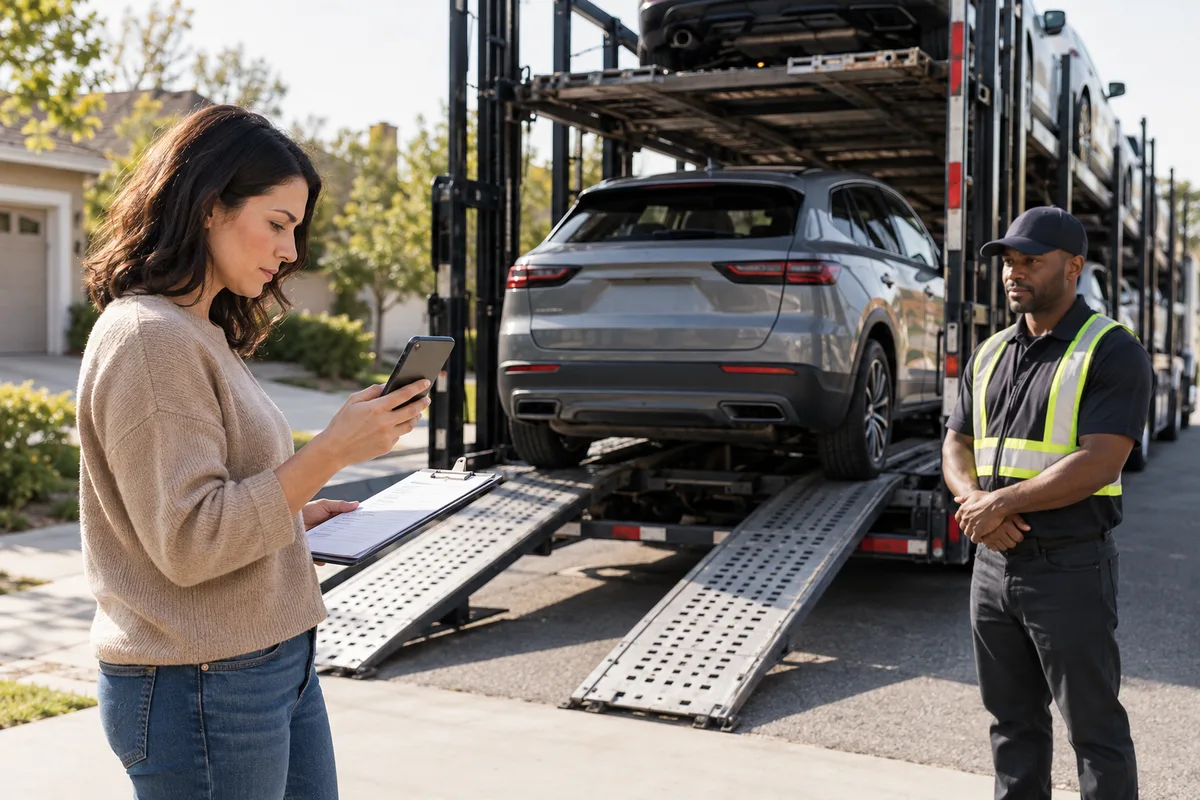
Compare the name and numbers on the truck with the carrier named on your paperwork before the keys change hands, as FMCSA advises.
FMCSA's fraud page, written for carriers and brokers, says: "Confirm the name and numbers on the truck that shows up to load are the same as the one with which you contracted." A carrier different from the one first named is not automatically a scam, because a broker assigns the carrier after booking. What matters is that the truck, the paperwork and a lookup of the USDOT number agree, and that any change was confirmed to you in writing. Run the lookup before the keys change hands. The USDOT number page covers where the number appears on a truck. Before a carrier is dispatched, Wave Auto Transport checks that its equipment and registrations are in order.
What does FMCSA say about MC numbers and its new registration system?
FMCSA's Registration Modernization FAQs say that if FMCSA stops issuing MC numbers, existing MC numbers will not be replaced by USDOT numbers, and FMCSA's May 2026 fact sheet on its new registration system, Motus, says existing USDOT and docket numbers will not change.
The FAQs state: "FMCSA has proposed no longer assigning MC Numbers." They also state: "If FMCSA stops issuing MC Numbers, existing MC Numbers will not be replaced by USDOT Numbers." And: "Existing registrants will keep their current USDOT Number." The FAQs page refers to a notice FMCSA published in the Federal Register on April 29, 2026 announcing Motus. FMCSA says the change to MC numbers would go through a Notice of Proposed Rulemaking and would not take effect with the first release of the new registration system. The fact sheet, "Changes to FMCSA Registrations in Motus", is dated May 2026 on the PDF and was last updated on its web page on Monday, May 18, 2026. It says: "Existing USDOT Numbers and docket numbers will not change." It also says: "Motus will continue to issue docket numbers." And on new numbers: "To help prevent fraud, Motus will randomize all newly issued USDOT Numbers and operating authority docket numbers." If you are checking a company against a scam, FMCSA says existing USDOT and docket numbers will not change, so a number a company prints today is not being withdrawn. The page on how to check if an auto transport company is legit covers the lookup, and the MC number page covers what an MC number registers.
Is a guaranteed delivery date a warning sign?
A guaranteed delivery date is a reason to ask what the promise is worth, not proof of a scam. Wave Auto Transport sells a guaranteed pickup window at a premium and publishes no guaranteed delivery date.
A pickup window is the span of days after booking in which the vehicle is collected. Transit time is a separate range of days for each route. The two add up to a total, so a company promising one exact arrival day is promising more than either figure states. Ask what the company does if the date passes, and look for that answer in the contract rather than in the sales call.
What paperwork protects me?
Two documents protect you: the contract you agree to before pickup, and the bill of lading you sign at pickup and again at delivery.
Read the contract's price and cancellation lines before paying anything. Under Wave Auto Transport's terms, you can cancel without penalty before Wave starts arranging your shipment with carriers. After that the deposit is non-refundable, unless Wave has not secured a carrier within 10 calendar days after your requested pickup date. The bill of lading is the sheet the pickup and delivery walkarounds are recorded on, and its guide covers what to check before each signature. If the car arrives damaged, the damage claims guide covers the first steps and which party a claim goes against.
Where do I report a car shipping scam?
Report a car shipping scam to the Federal Trade Commission at ReportFraud.ftc.gov, and contact your payment provider immediately if you already paid.
The FTC's page on what to do after paying a scammer gives separate first steps for each payment method and points to ReportFraud.ftc.gov as the place to report. FMCSA's fraud page lists further places to report. Complaints about how a carrier or broker behaved go to FMCSA; the damage claims guide explains that route and what a complaint does and does not do.
Frequently asked questions about car shipping scams
- Should I pay for car shipping by wire transfer?
Not to a company you have not verified. The FTC's wire-money page says: "Never wire money to anyone you haven’t met in person — no matter the reason they give." Its reason: "Scammers also know you won’t have the same protections you get by paying with a credit card." For a card, the FTC's page on credit card disputes describes a process for billing errors, which include a charge with the wrong amount and a charge for something you did not accept or that was not delivered as agreed. It says: "Send your letter so that it reaches the issuer within 60 days after the first bill with the error was sent to you." That page covers billing errors, not every disagreement with a company.
- What do I do if the driver demands more money at delivery?
Contact the company that arranged your shipment. If you suspect fraud, report it: FMCSA's fraud page says you can report scams and suspicious communications to the Federal Trade Commission, and ReportFraud.ftc.gov is where the FTC takes reports.
- Where can I see when a company's operating authority was granted?
On the Authority History page of FMCSA's Licensing and Insurance search. FMCSA's Get Operating Authority page, last updated Monday, April 20, 2026, gives the route: enter the MC number or USDOT number in the search, click "HTML" on the carrier result, scroll to the bottom and click "Authority History". FMCSA says that page displays the granted date of the operating authority.
- I already paid and the company stopped answering. What do I do?
Contact your payment provider immediately, because the FTC's first step depends on how you paid. For a credit card, report it to the card issuer and ask for a refund. For a debit card, Zelle or a bank transfer, report it to your bank or credit union and ask it to reverse the payment. For a wire transfer, report it to the wire transfer company and say you were tricked into sending money. For a payment app, report it to the app and ask it to reverse the payment. For a gift card or cryptocurrency, contact the issuer, exchange or ATM operator. Then report the scam at ReportFraud.ftc.gov.
- Besides the FTC, who else can I report a car shipping scam to?
FMCSA's fraud page lists the FBI's Internet Complaint Center, your local police, your state attorney general's office, the FMCSA Contact Center, the USDOT Office of the Inspector General Hotline and the FMCSA National Consumer Complaint Database. That page is written for companies whose identity was used, so it is a list of places to report to rather than a procedure for a customer. FMCSA updated it on Monday, April 7, 2025.
Last checked