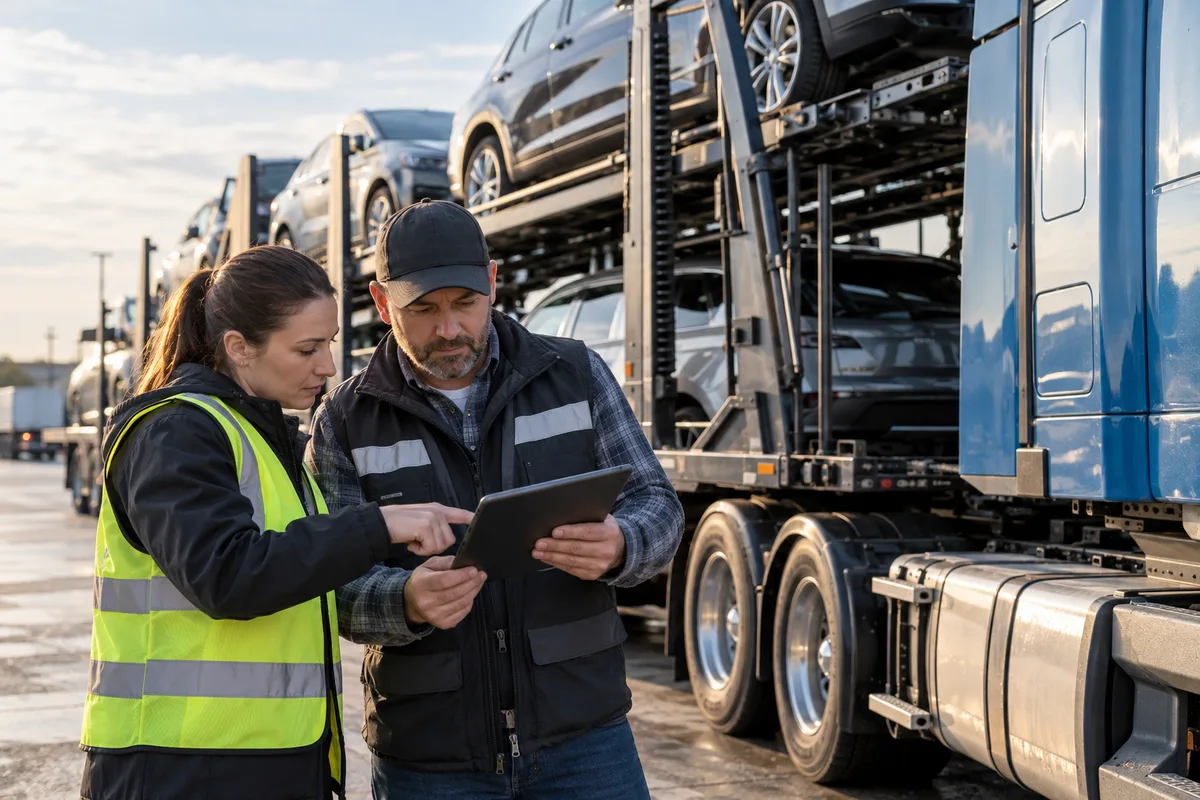
Check the number on the truck door before you hand over your keys. A USDOT number is the ID FMCSA issues to a motor carrier, and it has to appear on both sides of the truck.
A USDOT number starts with a form. 49 CFR 390.19T requires each motor carrier and intermodal equipment provider to file Form MCS-150, MCS-150B or MCS-150C with FMCSA, and directs a motor carrier operating in interstate commerce to file that Motor Carrier Identification Report. Read the number off the truck, and you can confirm which company is actually on file for that rig before the keys change hands.
Also called
DOT number, US DOT number, USDOT identification number, federal transport ID
Sources
8
Last updated
Why a USDOT number matters when you ship a car
A USDOT number matters at pickup because the number on the truck ties that rig to a federal file, and you can check it before handing over the keys. 49 CFR 390.21 requires the marking on a self-propelled commercial motor vehicle to carry the operating carrier's legal or single trade name together with "The identification number issued by FMCSA to the motor carrier or intermodal equipment provider, preceded by the letters 'USDOT.'", on both sides, legible "from a distance of 50 feet (15.24 meters) while the CMV is stationary." Compare that name and number to your dispatch paperwork before you release the car.
Where a truck carries more than one name, 49 CFR 390.21(b)(3) requires the operating carrier's name and number to appear preceded by the words operated by. A leased or subcontracted rig should still identify who's actually running it. Lettering that doesn't match your paperwork is worth a question on the spot.
Who is required to have a USDOT number
A USDOT number is required of any motor carrier operating a commercial motor vehicle in interstate commerce. 49 U.S.C. 31134 conditions that operation on being registered by the Secretary and receiving a USDOT number, and 49 CFR 390.3T applies the Federal Motor Carrier Safety Regulations to every employer, employee and commercial motor vehicle transporting property or passengers in interstate commerce. The trigger is a weight rating: 49 CFR 390.5T defines a commercial motor vehicle to include one with a gross vehicle or combination weight rating of 10,001 pounds or more, so an ordinary multi-car hauler falls squarely inside that definition.
Interstate commerce is a defined term. 49 CFR 390.5T covers transportation between two states, transportation between two places in one state by way of another state, and transportation between two places in one state that begins or ends outside it. A leg that never leaves one state can still qualify under that third branch when the vehicle's overall trip starts or finishes elsewhere.
USDOT number vs MC number
A USDOT number and an MC number answer two different federal questions: who's operating, and what they're registered to do. 49 U.S.C. 31134 attaches the USDOT number to operating a commercial motor vehicle in interstate commerce, while 49 U.S.C. 13901(a) attaches a separate registration to providing service as a motor carrier, a freight forwarder or a broker. You can ask a car shipping company both questions instead of one, because a number in a website footer names a business without stating which operating authority sits behind it.
A USDOT number also doesn't tell you whether the registration behind it is still in force. 49 U.S.C. 31134(c) lets the Secretary revoke a registration after notice and a hearing, or suspend one on notice, so a number printed in a footer states an identity, not a current standing. Confirm standing through the SAFER database.
USDOT number
Operating authority number
Governing section
49 U.S.C. 31134 and 49 CFR 390.19T
49 U.S.C. 13901
What the number stands for
an identification number issued by FMCSA on an identification report
registration to provide a named transportation or brokerage service
What triggers it
operating a commercial motor vehicle in interstate commerce
providing service as a motor carrier, freight forwarder or broker
Required on the truck body
yes, under 49 CFR 390.21
not the subject of that section
Where USDOT number requirements vary by state
States agree on what a USDOT number means and differ on which intrastate operations are required to have one. Federal sections are written for interstate commerce, so a carrier that never crosses a state line answers to whatever rule its own state wrote.
Rule in use
What it means in practice
Where it appears
Source
Checked
Operating a commercial motor vehicle in interstate commerce requires registration and a USDOT number
A car carrier crossing any state line is inside the federal requirement
49 U.S.C. 31134
law.cornell.edu/uscode/text/49/31134
September 2026
Vehicles operating totally in intrastate commerce rated 10,000 to 26,000 pounds need no USDOT number; above 26,000 pounds one is required
The exemption turns on the weight rating of the rig, not on the cargo
Maine Bureau of Motor Vehicles, Motor Carrier Services
Common carriers need one at 16,001 pounds gross vehicle weight or more; household goods carriers, solid waste carriers and named bus categories need one at any weight
A lower threshold than Maine's, and no threshold at all for several regulated carrier types
Washington Utilities and Transportation Commission
No national rule settles the intrastate question, and the two states above set different weight thresholds for the same identifier. Ask whether your move crosses a state line before treating a missing USDOT number as a red flag, because a small intrastate-only operator can sit under a state exemption that a long-haul carrier never touches.
Frequently asked questions about USDOT numbers
Is a USDOT number the same as an MC number?
No. 49 U.S.C. 31134 ties a USDOT number to operating a commercial motor vehicle in interstate commerce, while 49 U.S.C. 13901 ties an MC number to registration for service as a motor carrier, freight forwarder or broker.
Where does a USDOT number appear on a truck?
On both sides. 49 CFR 390.21 requires a self-propelled commercial motor vehicle to carry the operating carrier's name plus the FMCSA number "preceded by the letters 'USDOT.'", legible from 50 feet while stationary.
Does a car hauler that stays inside one state need a USDOT number?
The state decides. Maine exempts intrastate vehicles rated 10,000 to 26,000 pounds, while the Washington Utilities and Transportation Commission requires a number at any weight for several regulated carrier types.
Can a USDOT number stop being current?
Yes. 49 U.S.C. 31134(c) allows a registration to be revoked after notice and a hearing, or suspended on notice, so the standing behind a number matters more than the number's existence.
Sources and last checked
Supports
Each motor carrier and intermodal equipment provider must file Form MCS-150, Form MCS-150B or Form MCS-150C with FMCSA, and a motor carrier conducting operations in interstate commerce files the Motor Carrier Identification Report, Form MCS-150.
The marking on a self-propelled commercial motor vehicle must show the legal name or a single trade name of the operating motor carrier and the identification number issued by FMCSA preceded by the letters USDOT, on both sides, readable in daylight from 50 feet while the vehicle is stationary. Where other names appear, the operating carrier's information is preceded by the words operated by.
Operating a commercial motor vehicle in interstate commerce is conditioned on being registered by the Secretary and receiving a USDOT number, and a registration may be revoked after notice and an opportunity for a hearing or suspended on notice.
The Federal Motor Carrier Safety Regulations apply to all employers, employees and commercial motor vehicles that transport property or passengers in interstate commerce.
A person may provide transportation as a motor carrier, service as a freight forwarder, or service as a broker only if registered under that chapter to provide it.
Motor carriers operating totally in intrastate commerce with vehicles rated 10,000 to 26,000 pounds are not required to obtain a USDOT number; vehicles above 26,000 pounds must obtain one.
Common carriers need a USDOT number for intrastate operation at 16,001 pounds gross vehicle weight or more, or when hauling hazardous materials at any weight; household goods carriers, solid waste carriers, charter and excursion buses, auto transportation buses and non-profit buses need one regardless of weight.